


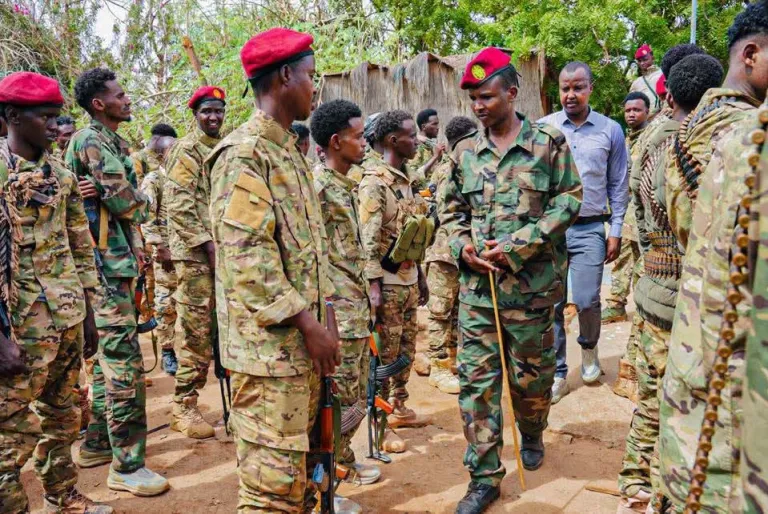


The District Commissioner of Doolow in Somalia’s Gedo region, Mohamed Hussein Abdi “Lafeey,” has spoken about the security and political situation in the region, calling for greater cooperation and caution amid continuing tensions between rival political and security actors.
Lafeey made the remarks on October 7 while visiting security forces in Doolow and units of the Jubaland Darawish forces.
He praised the cooperation between local security forces and Ethiopian troops stationed in the border area and urged security personnel to maintain what he described as a good working relationship between the two forces.
The district commissioner said that, until Somalia has a government capable of fully assuming responsibility for security and governance across the country, his administration would continue to take into account its relationship and cooperation with Ethiopian forces operating in the area.
Lafeey also instructed local security personnel to respect Ethiopian troops, saying they had been present in Somalia for many years and that their presence in the border region had been linked to security and stability efforts.
In remarks reported by several Somali media outlets, Lafeey went further, saying that Doolow would not implement policies that Ethiopia opposed while Ethiopian forces remained responsible for security in the area.
“Until a capable Somali government takes control of our affairs everywhere, we will look after what is best for our people, and we will not operate under a policy that Ethiopia does not agree with,” Lafeey said.
He also said that he would not become directly involved in the wider political confrontation in Gedo and reaffirmed his administration’s affiliation with Jubaland.
The remarks are particularly significant because Doolow is a strategic border town where Jubaland forces, federal-aligned forces and Ethiopian troops have been involved in overlapping security and political dynamics.
The European Union Agency for Asylum has previously documented competing areas of control in Gedo, including the presence of Jubaland and Ethiopian forces in Doolow and recurring tensions between the Federal Government and Jubaland.
Gedo has remained one of the most sensitive regions in Somalia’s political landscape, with disagreements between the Federal Government and Jubaland over administration, security arrangements and control of key towns.
Recent reporting indicates that tensions have again increased in the region, with different forces operating in and around Doolow, Luuq and Beled Hawo.
The developments come as political disagreements between Mogadishu and Jubaland continue to affect security arrangements in the region.
Doolow itself has also been closely associated with Jubaland’s security structures.
In September, Jubaland security chief Abdirashid Janan addressed security forces operating in Doolow and surrounding areas, urging them to focus on combating militant groups and protecting civilians.
Lafeey’s latest comments therefore place renewed attention on the role of Ethiopian forces in Gedo and the competing political authorities seeking influence in the region.
His position also comes at a sensitive time for Ethiopia’s regional relations.
Ethiopia is currently facing renewed fighting in Tigray and heightened tensions with Eritrea, Egypt and Sudan, developments that have increased concerns over broader regional instability in the Horn of Africa.
For Doolow and the wider Gedo region, the immediate challenge remains maintaining security while managing competing political interests and the presence of multiple security forces.
Lafeey’s remarks underline the importance local authorities place on cooperation with Ethiopian forces, while also highlighting the unresolved dispute over who should ultimately exercise security and political authority in Gedo.