


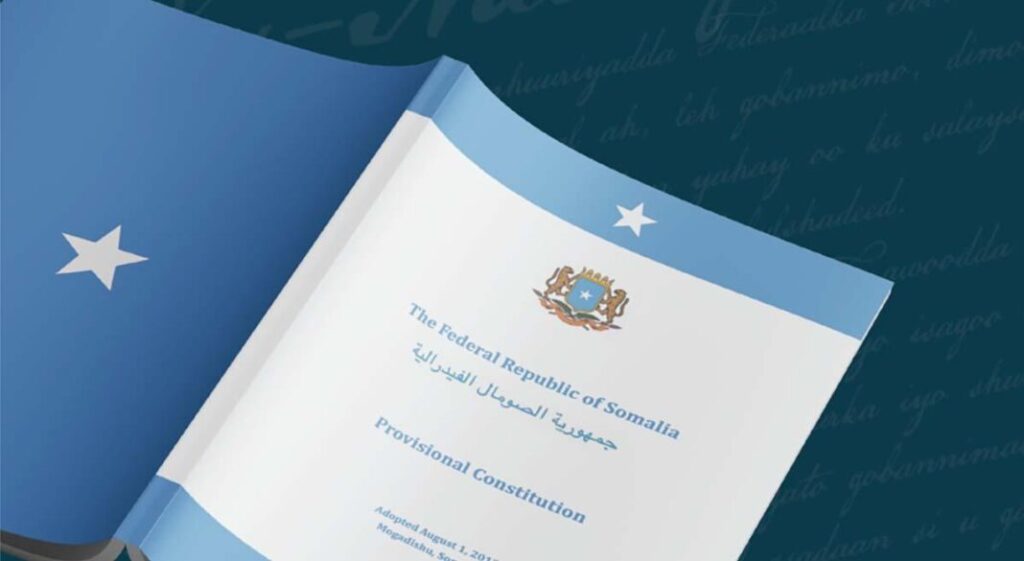


The question of whether Somalia has two constitutions has prominently featured in the country’s political and legal debates in recent days.
Many individuals argue that the 2012 Provisional Constitution remains in effect, while another faction references the amended constitution approved by both houses of the Federal Parliament.
This issue is not merely a dispute over the name or number of constitutions. It touches upon the powers of the President, the term of the Parliament, the electoral system, the relations between the Federal Government and Federal Member States, and who legally holds the authority to lead the nation.
Brief Answer: Somalia possesses a single federal constitutional framework originating from the 2012 Constitution; however, two opposing viewpoints exist regarding the amendments made and their legitimacy. This has led many to describe the situation as Somalia having “two constitutions.”
The 2012 Constitution: Where the Dispute Began
The Provisional Constitution of the Federal Republic of Somalia was adopted on August 1, 2012, by 822 delegates participating in the National Constituent Assembly.
This constitution served as the foundation for Somalia’s federal system, defining the powers of state institutions, citizens’ rights, the structure of Parliament, the Presidency, the Executive, the judiciary, and the regional member states.
It was designated as a provisional constitution because it was planned to undergo review and finalization as part of the constitutional-making process.
Consequently, the 2012 Constitution served as the legal baseline for federal institutions, although efforts to finalize it persisted for a long time.
The Amended Constitution: What Changed?
In March 2024, both houses of the Federal Parliament of Somalia approved amendments to the first four chapters of the Provisional Constitution.
Among these amendments were:
* Directing the country toward a universal suffrage (one-person, one-vote) election.
* Implementing a multi-party system.
* Extending the terms of the President and Parliament to five years.
* Granting the President the power to appoint and dismiss the Prime Minister.
The Federal Government characterized these steps as reforms building a comprehensive state governance system. The Office of the Prime Minister of Somalia stated on its official website that the amendments to the four chapters entered into force on March 30, 2024.
Nevertheless, the primary dispute arose from the process through which the amendments were enacted, the stakeholders included, and whether sufficient political consensus was achieved.
What Led to Claims That Somalia Has Two Constitutions?
This issue was further compounded by the Federal Parliament’s resolution on March 4, 2026.
In a joint session, both houses of Parliament approved additional amendments covering 11 chapters of the Constitution, which were subsequently signed by the President of the Federal Republic on March 8, 2026.
The Federal Government viewed this process as the finalization of the Constitution and the transcendence of its provisional status.
However, dissenting political factions argue that this process lacked a broad consensus involving all federal member states and opposition politicians.
First Position – The Federal Government: Argues that the approved amendments constitute the valid constitution of the country, and state institutions are fully empowered to operate under the new articles.
Second Position – The Opposition and Dissenting Member States: Argue that the 2012 Constitution remains the agreed-upon legal baseline, whereas the new amendments require broader political agreement and additional legal legitimacy.
Therefore, when it is said that Somalia has two constitutions, it generally refers to the two versions and two competing legal interpretations contesting national authority. It does not mean two completely independent constitutions are functioning concurrently without friction.
What Are the Positions of Puntland and Jubaland on the New Constitution?
Puntland and Jubaland are among the key actors that strongly opposed the constitutional amendment process.
On March 31, 2024, Puntland announced that it did not recognize the amendments, arguing that the new constitution requires an agreement involving all federal stakeholders alongside a public referendum.
Jubaland likewise joined the regional administrations rejecting the view that the amendments represented a mutually agreed consensus across the country.
This friction has impacted relations between the Federal Government and member states, particularly regarding elections, power-sharing, and the authority determining the future of the federal system.
It is important to understand that political rejection by a regional state is not legally equivalent to a judicial ruling invalidating a constitution.
What Did the Supreme Court Say Regarding the Constitutional Dispute?
The constitutional crisis assumed a new dimension on November 5, 2026, when the Supreme Court of Somalia issued a ruling addressing the controversy surrounding the constitutional amendments and federal institutional term limits.
The legal challenge was submitted by former Somali President Sharif Sheikh Ahmed, who contested the legality of measures derived from the constitutional amendments, particularly the tenure extensions of state institutions.
According to reports by *Garowe Online*, the Court delineated two core issues:
1. The lawsuit challenging the procedural methodology of the constitutional amendments.
2. The legality of the institutional term extensions resulting from those amendments.
The Court stated that the amendment extending terms from four to five years did not explicitly state whether the new duration applied to incumbent officeholders or future elected bodies.
Proceeding from this interpretation, the Court ruled that the previous four-year term applied to incumbent institutions, decreeing that:
* The mandate of both houses of Parliament concluded on April 14, 2026.
* The mandate of the President concluded on May 15, 2026.
* The Executive shall be restricted to routine daily administrative duties pending the organization of elections.
The Court also called upon stakeholders to agree on an electoral framework within 30 days, with national elections mandated within 90 days.
Crucial Caveat: This ruling cannot be construed as the Court entirely striking down all constitutional amendments. As reported by *Garowe Online*, the decision specifically targeted the retroactive application of term extensions to incumbent institutions.
Comparison: 2012 Constitution vs. Amended Version
| Provision | 2012 Provisional Constitution | New Amendments |
| Presidential Term | 4 years | 5 years |
| Parliamentary Term | 4 years | 5 years |
| Elections | Indirect electoral model | Universal suffrage (one-person, one-vote) planned |
| Political Parties | Prior system | Multi-party system |
| Prime Minister | Parliament maintained a vital role in government confidence | Appointed and dismissed by the President |
This comparison highlights the core disputed provisions, though it does not constitute an exhaustive list of all amendments introduced during the review process.
The constitutional dispute is not confined solely to the President and the opposition; it threatens broader ramifications for political life, security, and state-building.
1. Elections: Absent a consensus on the constitution and electoral rules, establishing a universally accepted electoral framework remains exceedingly difficult.
2. Federalism: Disagreements between the Federal Government and regional states over the foundational legal compact complicate intergovernmental coordination.
3. Judiciary: The implementation and adherence to Supreme Court rulings by coordinate branches remain critical for sustaining public trust in the justice system.
4. Security: Unresolved political friction risks impairing security sector cooperation and disrupting coordinated counter-insurgency operations against Al-Shabaab, a vulnerability highlighted by regional security analysts.
Can Somalia Function with Two Competing Legal Frameworks?
In the Federal Republic of Somalia, the overriding principle dictates that the nation must operate under a single federal constitution defining national institutional powers and intergovernmental relations.
While an original text and an amended version may coexist, disputes over the legitimacy of amendments cannot be resolved by rival factions unilaterally declaring their preferred text supreme.
Key questions requiring resolution include:
* Did the amendment procedure comply with the articles of the 2012 Constitution?
* Were all relevant federal stakeholders genuinely included?
* What are the legal powers and jurisdictional boundaries of the Supreme Court?
* How will the Court’s ruling of November 5, 2026, be enforced?
* How can inclusive political consensus be forged to resolve the deadlock?
Furthermore, while Somaliland maintains its own constitution and distinct legal apparatus, that dynamic represents a separate political and legal question distinct from the debate surrounding the dual versions of the Federal Somali Constitution.