

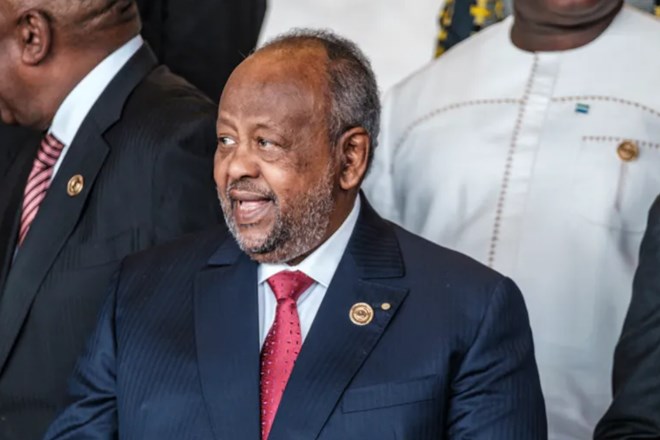
DJIBOUTI (KAAB TV) – Djibouti’s National Assembly has voted to abolish the constitutional age limit for presidential candidates, clearing the path for President Ismail Omar Guelleh to seek a sixth term in office despite being 77 years old.
All 65 lawmakers present in Sunday’s special session backed the amendment, which removes the age cap of 75 years previously imposed by the constitution.
The proposal now awaits presidential assent and a second parliamentary vote on November 2, or alternatively, it may be submitted to a national referendum.
If finalized, the decision would allow President Guelleh — known popularly as IOG — to run in the upcoming April 2026 elections, potentially extending his more than quarter-century rule.
Guelleh first came to power in 1999, succeeding Djibouti’s founding president Hassan Gouled Aptidon.
Under his leadership, the small Horn of Africa nation has become a key hub for global military and trade interests, hosting bases from the United States, France, China, Japan, and Italy.
The age restriction was originally introduced by Guelleh himself in 2010, part of a constitutional revision that removed presidential term limits but reduced the mandate from six to five years.
Speaking after the vote, National Assembly Speaker Dileita Mohamed Dileita defended the change, describing it as “a measure to ensure political continuity and national stability amid regional turbulence.”
He claimed that more than 80 percent of citizens support the reform, although KAAB TV could not independently verify that figure.
Human rights groups and opposition figures have sharply criticized the move.
“This revision prepares a presidency for life,” said Omar Ali Ewado, head of the Djiboutian League for Human Rights, urging a peaceful and democratic transition of power.
Daher Ahmed Farah, leader of the opposition Movement for Democratic Renewal and Development (MRD), told Al Jazeera that the international community should “rethink its partnership priorities,” emphasizing that “Djibouti’s strategic importance should benefit its people, not just one individual.”
Guelleh secured a fifth term in 2021, winning more than 98 percent of the vote after most opposition parties boycotted the election.
While the United States congratulated Djibouti on the peaceful polls, it also urged the government to “strengthen democratic institutions” and implement observer recommendations.
In a recent interview with Jeune Afrique, Guelleh hinted he had no immediate plans to step aside, saying, “I love my country too much to embark on an irresponsible adventure and be the cause of divisions.”
Guelleh is currently East Africa’s third-longest-serving leader, following Uganda’s Yoweri Museveni and Eritrea’s Isaias Afwerki.
Despite its population of just over one million, Djibouti’s strategic position on the Bab al-Mandab Strait — a chokepoint for global trade between Asia and Europe — has ensured its stability even as neighbors like Sudan and Somalia grapple with conflict and instability.
Analysts say that very strategic leverage, however, has also helped shield Djibouti’s government from external pressure for political reforms, raising questions about the balance between stability and democracy in one of Africa’s most geopolitically significant states.