

MOGADISHU (Kaab TV) – Jawaahir Ibrahim Iimaan, a mother of seven, fled her home in Awdheegle, Lower Shabelle, two months ago after fierce clashes erupted between Al-Shabaab and Somali government forces.
The sound of heavy gunfire and shelling shattered her last hopes of staying. Carrying her children, she escaped under fire, seeking safety in a life still clouded by uncertainty.
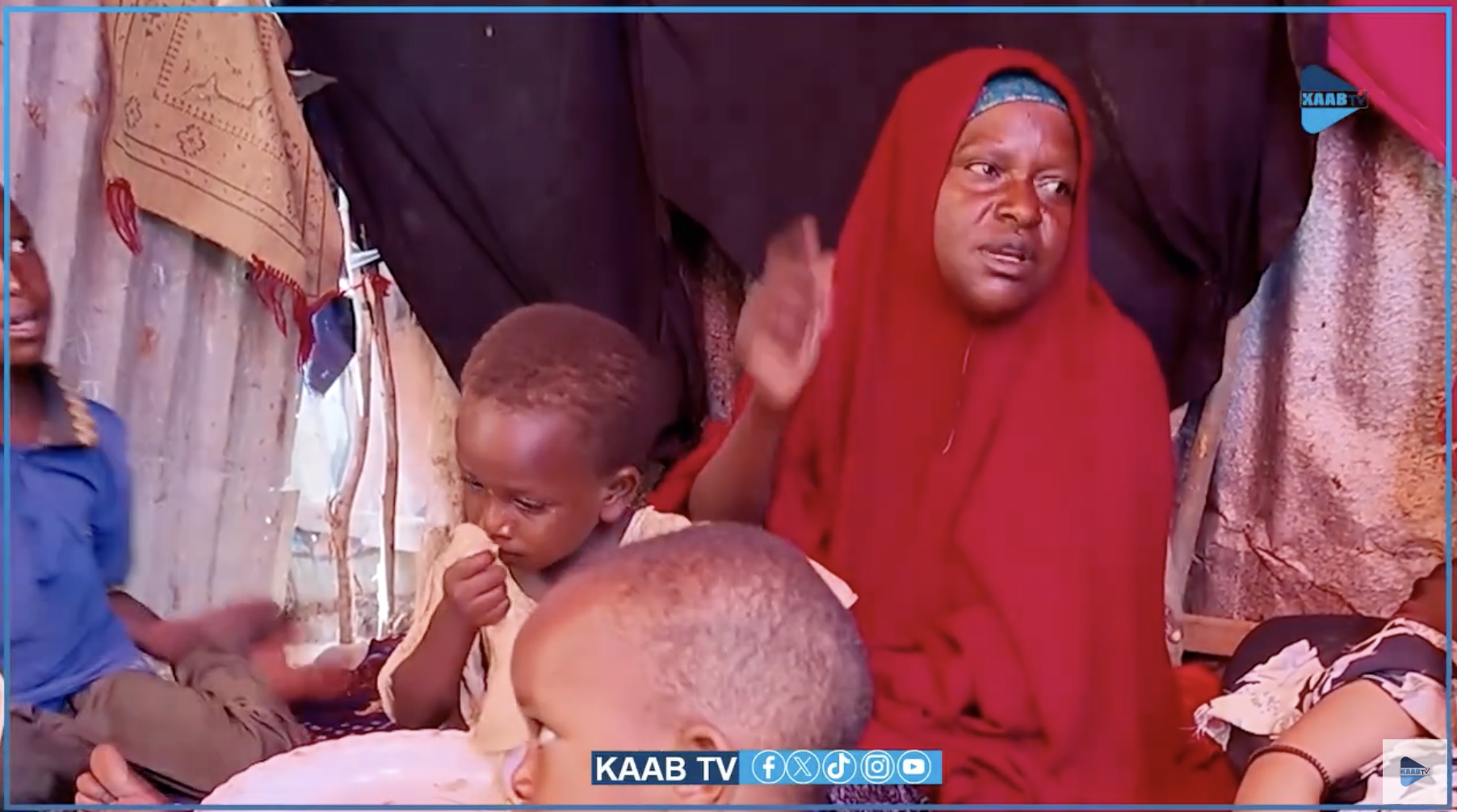
“War, suffering, and explosions drove us out,” Jawaahir said, sitting at the doorway of her makeshift hut in an overcrowded camp for displaced people, the heat of the midday sun visible on her face.
After days on the road, she arrived at Barxad-weyn camp in Kaxda district, Mogadishu. But survival here comes with new challenges: no clean water, inadequate shelter, little food, and no access to healthcare.
“Sometimes food is cooked in the camp and shared in spoonfuls,” she said. The biggest struggle, however, is clean water. “Two jerrycans cost 3,000 shillings (USD 0.15). If you don’t have money, you don’t get water.”
Camp “gatekeepers,” who control settlements, are accused of charging rent for plots of land while also taking a share of aid meant for displaced families.

Faadumo Abdulkadir, a widow with six children, fled Sabiid and Caanoole near Afgooye after Al-Shabaab retook the area last month. When Kaab TV visited, she and other women were busy building a small hut to shelter her children.
“I’ve been here four days. We fled war and hunger,” she said. “I have no money for my children’s education. We all sleep together in this tiny hut.”
War and Climate Fuel Displacement
Somalia continues to reel from a cycle of conflict, droughts, floods, and insecurity, driving hundreds of thousands from their homes. Aid agencies estimate that more than 3.3 million people are currently displaced inside the country.
Overcrowded camps lack safety, and women—especially those without male relatives—face frequent nighttime attacks by armed men.
Ca’isha Adam Mohamed, a mother of three—two of them orphans—escaped her village near Bariire, Middle Shabelle, during recent fighting between African Union and Somali troops against Al-Shabaab.
“Mortar shells landed on our village. I fled on foot with my children until we found a vehicle near Afgooye,” she said. Now living with her father, who pushes a cart in Mogadishu to feed the family, she describes nights when her children go to sleep crying from hunger.
Aid Cuts Deepen Crisis
The Norwegian Refugee Council (NRC) recently warned that sharp cuts in humanitarian funding have left more than 300,000 Somalis without food and clean water assistance, raising the risk of preventable diseases.
“Somalia is being pushed to the brink by the combined impact of relentless conflict, climate extremes, and a sharp drop in international support,” said Mohamed Abdi, NRC’s Country Director in Somalia.
“We are seeing the human cost of inaction every day, in the suffering of children too weak to walk, in the empty jerrycans, and in the avoidable deaths from waterborne diseases. This is a man-made disaster that can still be prevented.”
Earlier this year, the United Nations appealed for $1.42 billion to assist 4.6 million Somalis, but so far only 17% of that has been funded. As a result, aid groups have been forced to scale back, leaving millions of vulnerable families without support.