

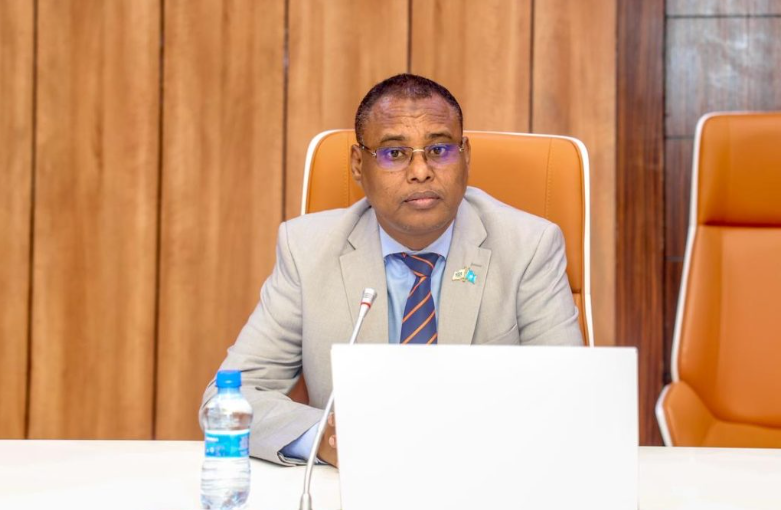

Somalia’s Second Deputy Prime Minister, Abdirashid Jibril, has announced that he has returned his Kenyan passport and renounced his Kenyan citizenship, becoming the first senior government official to publicly comply with Hassan Sheikh Mohamud’s directive requiring cabinet ministers and other top officials to surrender Kenyan travel documents or leave office.
Speaking in a video shared on social media, Jibril said he visited the Kenyan Embassy in Mogadishu on Monday, where he officially handed over his Kenyan passport.
He maintained that the passport had been obtained legally through his ancestral lineage, rejecting allegations that it had been acquired fraudulently.
“They lied about my nationality, but because of the current circumstances, I decided to renounce my Kenyan citizenship,” Jibril said, adding that his decision was intended to comply with the government’s directive and put an end to the controversy.
His announcement follows weeks of diplomatic tensions between Somalia and Kenya after he was denied entry into Nairobi in late June.
According to a Kenyan police report cited by local media, Jibril arrived at Jomo Kenyatta International Airport on June 24 using a Somali diplomatic passport and a valid Kenyan visa.
Immigration officials questioned him over a Kenyan passport they believed had been obtained unlawfully.
Kenyan authorities alleged that he had acquired the passport illegally and accused him of mobilizing clan militias to destabilize the Kenya-Somalia border, allegations that Jibril has denied.
After questioning, Kenyan authorities deported him back to Mogadishu and launched an investigation into how the passport had been issued. Nairobi has not publicly announced the outcome of that investigation.
The controversy widened after Somalia’s State Minister at the Presidency, Abshir Bukhaari, was also reportedly denied entry into Kenya when immigration officials questioned a Kenyan passport he was allegedly carrying.
Neither the Kenyan nor Somali governments have issued an official statement regarding that incident.
Somali media have also reported that Kenyan immigration authorities placed nearly 30 Somali government officials on airport watchlists, resulting in several reported refusals of entry in recent weeks, although Kenyan authorities have not publicly confirmed the reports.
The passport dispute prompted Hassan Sheikh Mohamud to order ministers and senior government officials holding Kenyan passports or Kenyan identity documents to surrender them or vacate their positions, a directive that has reportedly exposed divisions within the Federal Government.
Some officials argue that Somalia’s nationality law recognizes dual citizenship and does not automatically revoke Somali nationality when another citizenship is acquired. Kenya’s Constitution likewise permits dual citizenship.
Legal experts, however, note that surrendering a passport and renouncing citizenship are separate legal processes.
While a passport is simply a travel document, citizenship is a legal status that, under Kenyan law, requires a formal declaration and approval by the relevant authorities before renunciation becomes effective.
Jibril’s statement that he has renounced his Kenyan citizenship marks a significant development in the controversy.
However, legal observers note that Kenyan authorities may still continue any investigation into the circumstances under which the passport was originally issued, regardless of whether it has since been returned.
The dispute has also renewed scrutiny of Kenya’s immigration system.
Immigration Principal Secretary Belio Kipsang has previously stated that non-Kenyans are issued only alien registration documents, a position that appears inconsistent with reports that several senior Somali officials possessed Kenyan passports.
Although the passport controversy temporarily strained relations between the neighboring countries, both governments have recently sought to de-escalate tensions.
Senior Somali and Kenyan officials met in Addis Ababa in recent weeks, where they agreed to strengthen cooperation on immigration, border management, and consular affairs in an effort to prevent similar disputes from undermining bilateral relations.