




MOGADISHU (Kaab TV) — Somalia has announced plans to introduce Kiswahili language courses at local universities and urged business owners to adapt to the East African Community (EAC) market.
Somalia formalized its bid to join the EAC bloc in March 2024. However, due to insecurity, widespread corruption, and the persistent threat of the Al-Shabaab militant group, the Horn of Africa nation has yet to enjoy the free movement benefits available within other EAC member states.
For example, neighboring Kenya recently eliminated the Electronic Travel Authorization (ETA) requirement for citizens of nearly all African and Caribbean countries — but Somalia and Libya remain exceptions to this visa-free policy due to security concerns.

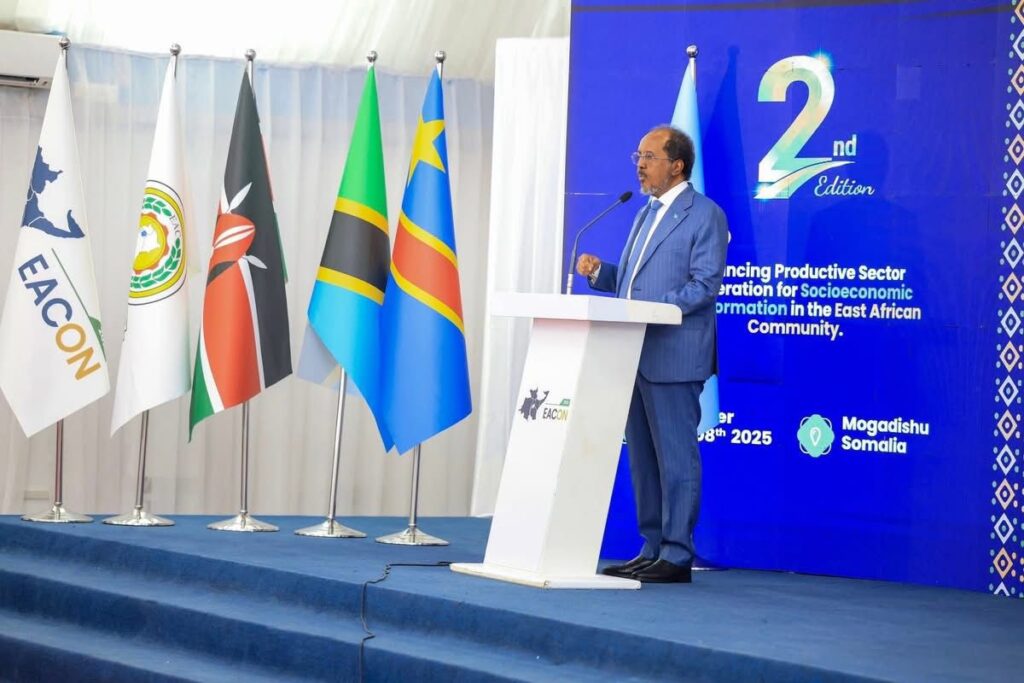
On Tuesday, Somali President Hassan Sheikh Mohamud underscored the importance of teaching Kiswahili in Somali universities.
“All universities, especially the Somali National University, should allocate significant resources to teaching Kiswahili, the language of East Africa,” President Mohamud said during the East Africa Business Forum in Mogadishu.
For his part, Somali Minister of Education Farah Abdukadir confirmed that Swahili would be incorporated into university curricula.
“We are continuing to teach Swahili — the language spoken across the East African Community — within our education system so that the number of Somalis who speak Swahili will eventually surpass those who speak English,” Minister Farah Abdukadir stated.
Swahili is spoken in more than a dozen countries, primarily across East and Central Africa, including Tanzania, Kenya, Uganda, the Democratic Republic of the Congo, Burundi, and Rwanda.
The EAC promotes Kiswahili as an inclusive and unifying language across the region.
However, critics in Somalia argue that the initiative contradicts the country’s Provisional Constitution, which recognizes Somali and Arabic as the two official languages, with Maay and Maxaa Tiri being the main local dialects.
“Our Constitution guarantees two official languages — Somali and Arabic — while Somali itself has two main dialects. Therefore, any change to that is unconstitutional,” said Omar Barre, a university lecturer in Mogadishu.
A university student also questioned how the new language policy could be implemented when many Somali students still lack access to free primary education.
“If the government cannot provide basic education for children, how can it afford to fund new language-learning courses at universities, which can be costly?” said Ahmed Nur, who lives in Garowe.
English, nonetheless, remains widely taught and used in higher education and commerce throughout Somalia.