

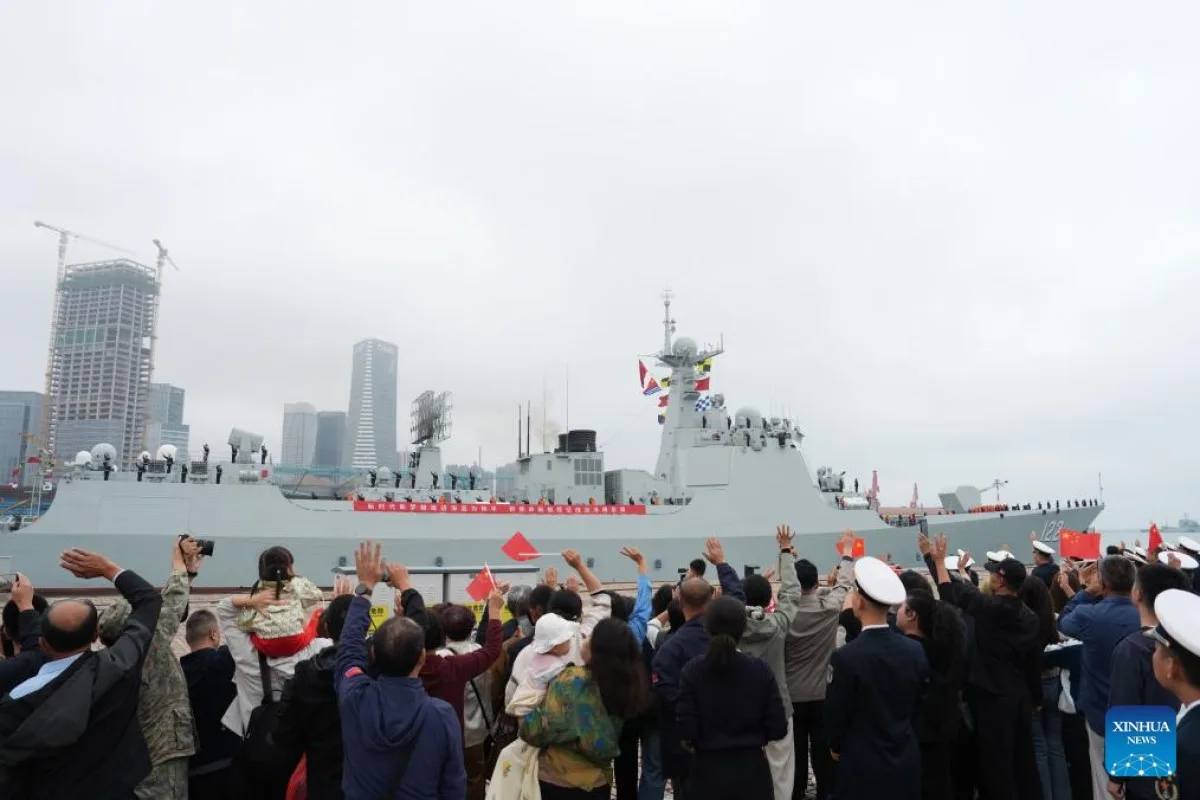
MOGADISHU (Kaab TV) – The Chinese Communist Party (CCP) is intensifying its engagement in East Africa, as Beijing announced the deployment of a new contingent of the People’s Liberation Army Navy (PLA Navy) to the Gulf of Aden and the waters near Somalia this week.
According to China’s Ministry of National Defense, the naval fleet comprising the guided-missile destroyer Tangshan, the frigate Daqing, and the supply ship Taihu departed from a military port in eastern China on Saturday. The mission, China’s 48th naval escort operation in Somali and Gulf of Aden waters since 2008, will focus on maritime security operations, including protecting commercial vessels and safeguarding key international shipping routes.
“These operations demonstrate China’s firm commitment to building a maritime community shared by all nations and to maintaining regional peace and stability,” said ministry spokesperson Jiang Bin.
The Gulf of Aden is one of the world’s most strategic waterways, connecting the Indian Ocean to the Red Sea and serving as a critical corridor for global trade and oil shipments.
Somalia, with its long coastline and ongoing security challenges, remains vulnerable to piracy and maritime crime. Analysts say the PLA Navy’s deployment could help deter such threats, but it also reflects Beijing’s growing strategic ambitions in the region.
In recent months, China has expanded its engagement with multiple Somali political actors. Beyond its close ties with the federal government in Mogadishu, Beijing has reportedly provided financial assistance and “development aid” to the Laascaanood-based northeast state, which declared independence from Somaliland in 2023.
At the same time, China is aggressively countering Taiwan’s diplomatic presence in Somaliland, where Taipei maintains a representative office established in 2020. Beijing has stepped up political and economic outreach across Somalia to isolate Taiwan and reinforce its “One China” policy within the Horn of Africa.
China’s broader security involvement in Africa is guided by its Global Security Initiative (GSI) a framework that integrates security cooperation with political partnerships and governance exchanges. Through the GSI, China seeks to strengthen ties with ruling parties, secure favorable treatment for Chinese enterprises, and build diplomatic support for its global agenda.
However, the expansion of Chinese security operations across Africa has drawn criticism. Chinese-made weapons have previously surfaced in conflict zones such as Mali, Darfur, South Sudan, and the Democratic Republic of Congo. Rights groups have also accused some African governments of using Chinese surveillance technology to monitor and suppress political opposition.
These developments have fueled growing skepticism among segments of African civil society, who view Beijing’s increasing military and political footprint as reinforcing authoritarian practices rather than promoting inclusive governance.
While China maintains that its actions aim to promote “shared security and stability,” critics warn that its deepening presence in Africa reflects a strategic effort to reshape regional power dynamics in line with its own interests.