


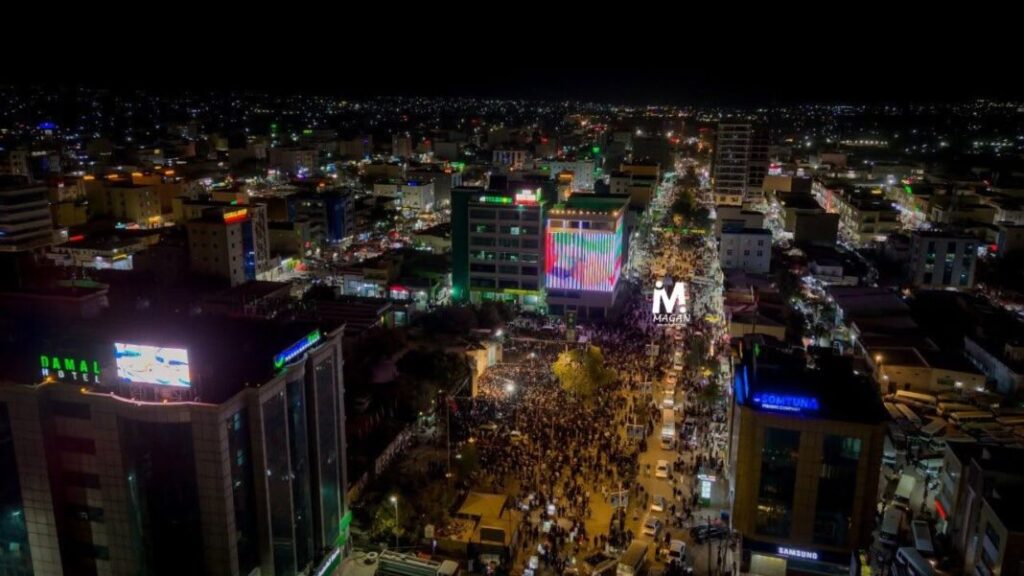


Demonstrations of joy and public celebrations were palpable across the city of Hargeisa among sections of the Somaliland public, following remarks by U.S. President Donald Trump during a political rally in which he characterized Somaliland as a place entirely distinct and different from Somalia.
Those statements triggered widespread political reactions and reignited fresh hope among citizens regarding Somaliland’s ongoing efforts to secure international recognition.
The celebrations erupted after reports and viral video footage circulated across social media platforms, showing citizens celebrating Trump’s statements, with his portrait and the United States flag displayed across several prominent buildings in Hargeisa.
The public display was widely interpreted as a demonstration of support and growing optimism that relations between Somaliland and the United States could reach a new strategic milestone.
Donald Trump delivered these remarks on October 12, 2026, while addressing a political campaign rally in Youngstown, Ohio.
During his address, he characterized Somaliland as distinct from Somalia while also suggesting that its name should be modified to avoid confusion.
Trump’s statements swiftly dominated news outlets and social media platforms, particularly in Somaliland, where persistent diplomatic campaigns have long been underway to secure formal international recognition.
A cross-section of Somaliland citizens viewed the U.S. President’s remarks as a major political developments, believing that such explicit validation from a powerful global leader could significantly elevate international awareness regarding Somaliland’s political status and sovereignty claims.
However, Trump’s remarks were not delivered as a formal decision recognizing Somaliland, nor were they accompanied by an explicit declaration stating that the United States government has altered its recognition policy.
Somaliland’s Ministry of Foreign Affairs and International Cooperation issued a press release on October 13 welcoming Trump’s remarks, describing them as reflective of the political reality that Somaliland has long advocated.
The press statement noted that Somaliland possesses defined borders, a constitution, a democratically elected government, and its own state institutions, having functioned as a self-governing entity for over thirty years.
The Somaliland administration also expressed a strong desire to deepen relations with the United States, particularly in security, trade, investment, and regional cooperation.
The Somaliland government has long maintained that its sovereignty is rooted in historical precedent, asserting that it gained independence on June 26, 1960, prior to unifying with former Italian Somaliland.
Somaliland contends that it reclaimed its independence on May 18, 1991, following the collapse of Somalia’s central government.
Although Trump’s comments generated optimism and jubilation in Somaliland, a clear distinction must be drawn between political commentary and formal state recognition.
The legal recognition of a sovereign state requires a definitive, official executive act by the government concerned.
The U.S. President’s characterization of Somaliland as a place distinct from Somalia was not accompanied by an official announcement from Washington formally recognizing Somaliland as an independent state.
Consequently, the celebrations in Hargeisa appear driven by the anticipation that Trump’s remarks could open new diplomatic avenues, rather than celebrating a formal declaration of recognition issued by the United States.
In recent years, Somaliland has invested intense efforts into securing political and diplomatic support from the United States and other foreign powers.
The Hargeisa administration has repeatedly emphasized that Somaliland’s strategic location, extensive coastline, and the Port of Berbera are crucial for international trade and maritime security across the Gulf of Aden corridor.
Conversely, the United States maintains vital security and strategic interests in the Horn of Africa, including counter-terrorism operations, safeguarding commercial shipping, and ensuring the stability of maritime choke points critical to global trade flows.
The Somaliland government anticipates that these intersecting priorities could pave the way for expanded bilateral cooperation with Washington, though it remains unconfirmed whether Trump’s remarks will translate into a formal shift in U.S. foreign policy.
Another point arising from Trump’s statement is his recommendation that Somaliland modify its national name.
This suggestion has ignited intense debate among citizens and political figures in Somaliland, with many viewing the name ‘Somaliland’ as a historic and political symbol that cannot easily be relinquished.
Proponents of Somaliland’s independence insist that the name is intrinsically tied to the territory’s distinct history and its long-standing quest for international recognition.
On the other hand, Trump’s remarks have revived broader debate regarding how Somaliland should navigate its strategic engagement with the United States and its overarching recognition campaign.
The Somaliland issue has long served as a central point of political contention between the Hargeisa administration and the Federal Government of Somalia.
The Federal Government continues to firmly uphold the unity, sovereignty, and territorial integrity of Somalia, whereas Somaliland maintains that it is an independent state that successfully reclaimed its historic sovereignty.
Trump’s remarks therefore carry political significance that extends far beyond the public celebrations in Hargeisa, as they reignite the broader debate regarding the future trajectory of relations between Somaliland, Somalia, and the United States.
The celebrations in Hargeisa underscore the paramount importance that international recognition holds for a significant segment of the Somaliland public.
Any statement issued by leaders of major global powers possesses the potential to profoundly influence the political aspirations of a population that has long strived for formal international recognition.