

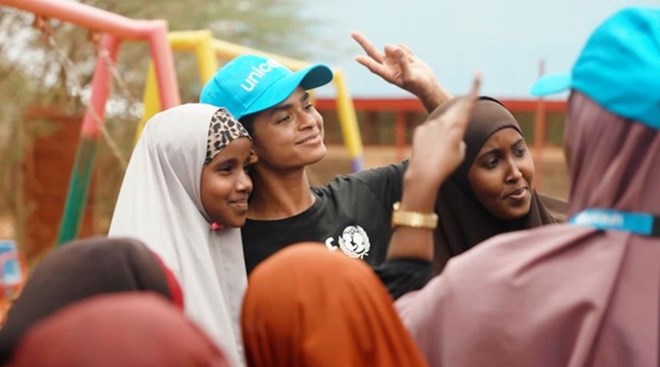
Dadaab (KAAB TV) – Somali-born boxer Ramla Ali has spent her life fighting — first for survival, then for change. From escaping Somalia’s civil war to stepping into the Olympic ring, she’s turned her own story of struggle into a powerful mission to uplift others.
Now, the boxer, model, and UNICEF ambassador is using her platform to advocate for displaced people and girls’ education. Her latest journey took her to Kenya’s Dadaab refugee camp, one of the largest in the world.
Ali fled Somalia with her family after her brother was killed during the civil war. They spent about a year in Kenya before resettling in London, where Ali discovered boxing as a teenager. What began as a way to gain confidence and escape bullying became a lifelong calling.
“I was a young girl, bullied in secondary school,” she told CNN. “Boxing was a space where I could make friends. I was gaining confidence as my body changed, and I was getting healthier. That’s what I loved most — and over time it became something I wanted to master.”
Her rise was extraordinary. Ali won England’s national and Great British titles and claimed the 2019 African Zone Featherweight Crown as an amateur boxer. In 2020, she made history as the first boxer to represent Somalia at the Olympics, in Tokyo — becoming a symbol of resilience and representation.
“You can’t be what you can’t see,” Ali said. “If people can see me doing it, then maybe they’ll believe they can too.”
“This could have been me”
In September, Ali’s path came full circle when she returned to Kenya with UNICEF and the Danish Refugee Council, visiting communities in Nairobi’s Dandora and Eastleigh neighborhoods and later traveling north to Dadaab.
There, she met girls, mothers, and teachers working to build better futures despite dwindling aid. For Ali, the experience was an emotional reminder of what could have been.
“Had I not left Kenya, this could have been me,” she said. “It’s humbling to see how these women are doing everything they can to give their kids a chance.”
At the Kasarani Sasa recycling group in Dandora, a collective of more than 200 waste pickers — mostly refugee women — Ali joined in with the work, helping to sort and weigh plastic and cardboard. The program provides childcare and informal education for their children while offering mothers a safe way to earn an income.
“You always think about these things, but when you see it firsthand, it’s different,” Ali said. “If we hadn’t left Kenya, this could have been my mum in this situation. It’s heartbreaking, because you want to help everyone — but there are so many.”
At FilmAid Kenya, a creative learning program in Dadaab that teaches filmmaking and storytelling to young refugees, Ali shared her own story with students. Many of the girls, she said, had dreams of becoming doctors, nurses, or psychologists — despite the challenges of growing up in a camp.
“It was really important for me to tell them how education changed my life,” she said. “Even in an environment like this, they’re still hopeful and determined to achieve their dreams. Every dream matters.”