


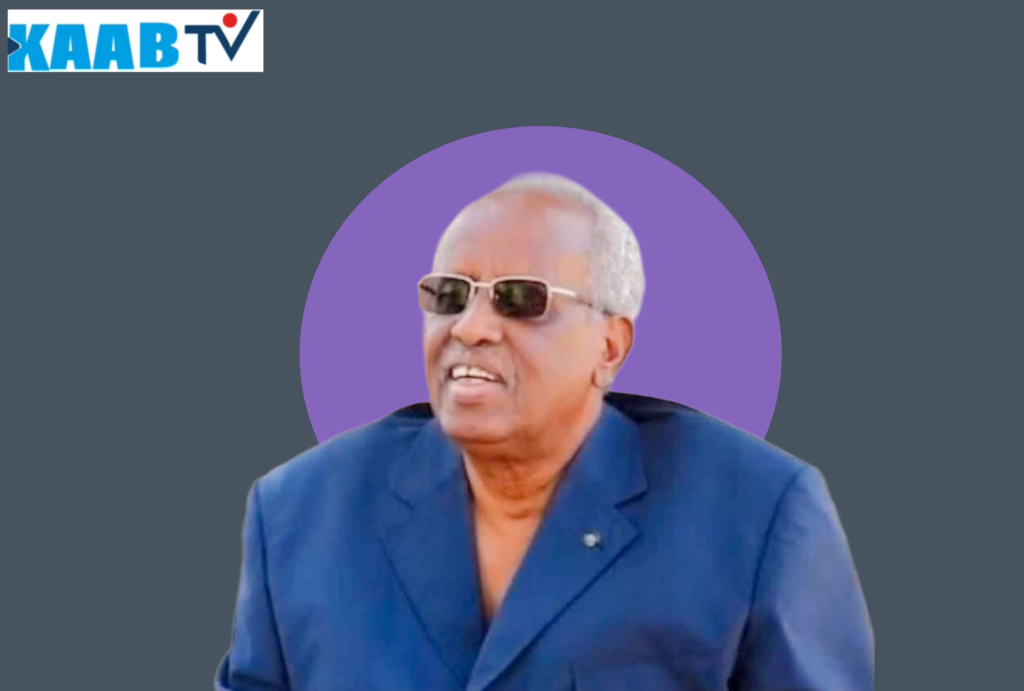


“Or go and visit Boobe
At his home in Taiwan.”
—Late Mohamed Ibraahim Warsame Hadraawi, may Allah have mercy on him.
I have tried in every way to express, through writing, something of the remarkable personality of Abdirahman Yuusuf Duale (Boobe), but I have been unable to do so, and I remain overwhelmed by the task.
Dozens of times I have opened my writing notes and told myself that I should say something about the man he was and the significant role he played. Yet, neither in the past nor now, have I been able to find the words.
I never imagined that a day would come when my pen would fail me like this, or when I would find myself unable to bring myself to write.
What will I remember you for, Boobe? I will remember you for the person you were! That is all.
He was a man of struggle, achievement, service, substance and practical contribution. Boobe began leading the affairs of the world around him while he was still barely out of secondary school.
From Italy to the Taiwan neighbourhood of Dire Dawa, where the armed struggle had taken root, his record player and his rifle followed one another.
Just as Maxamed Mooge carried both a pen and a gun, and was a great teacher and freedom fighter, so too was Boobe. His writing is the most significant chapter in his history.
A great man has passed away, but what a remarkable life he lived.
When it comes to categorising Somali literature, writing is among the most demanding disciplines, one that not everyone can undertake. And when it comes to documenting events through written accounts, that is an entirely different exercise in itself.
Bearing this in mind, if we examine Boobe’s writing, we can appreciate how close he remained to truth and fact, and how faithfully he documented the actual events of history.
Not every writer is like this. Sometimes writers are driven by personal interests and allow their own inclinations, or loyalty to particular individuals, to influence the information they present. But Boobe? Never.
Becoming a good writer who commands considerable respect within their community requires dedication, time and commitment that sustains a person even when they encounter difficulties. At the heart of time, effort and determination lies an individual’s talent, which can enable them to build a great reputation over time.
Beyond all these qualities, there is another important factor that can make a writer who possesses them truly exceptional: personal awareness and a mature understanding of their society and surroundings.
If you are not conscious of what is happening around you, then whatever talent or dedication you possess, what you produce will lack substance.
Mr Boobe was a social guide and advocate. During the seventy-eight years he spent in this world (1948–2026), he devoted himself to public service: as a freedom fighter, writer, government official, opposition figure and, ultimately, an elder statesman who helped untangle difficult matters and resolve disputes.
He was born and raised in the Caanaha Riyaha neighbourhood. From Quranic school through primary and intermediate education, he studied in Hargeisa, before completing his secondary education in Mogadishu in 1968.
That same year, he received a scholarship to study in Italy, where he learned Italian during his first year there.
By 1971, he was among the students who revolted against the socialist system in place in that country, which they believed did not serve their interests. They launched a protest and took over their country’s embassy, administering it themselves for two days.
This led to arrests and a lengthy legal case, which eventually resulted in their deportation.
After returning home, he once again travelled abroad, this time to Russia, where he spent a year studying.
He was among those who worked for the Somali Revolutionary Socialist Party, particularly in its Ideology Department. He was also among the editors of the party’s newspaper, Halgan.
At this point, in 1981, Boobe joined the armed movement of Western Somalia, the SSDF.
That same year, Boobe was once again sent to attend a conference in Geneva, Switzerland. The following year, in 1982, Mr Boobe left the SSDF and joined the Somali National Movement (SNM) directly.
The Pen and Boobe
In 1968, while completing his secondary education, the writer began collecting material and writing his first book, Diiwaanka Maansada Timacadde (The Anthology of Timacadde’s Poetry).
That book was published in 1983, after he had devoted fifteen years to working on it. His next book was published in 2004, twenty-one years later.
In total, thirty-six years separated the publication of his two books. This alone stands as testament to the seriousness and sense of responsibility that characterised Boobe Yuusuf Ducaale as a writer.
The writer Ibraahin Yuusuf Axmed (Hawd), bearing witness to this same quality, once said:
“May Allah honour Boobe Yuusuf Duale in this life and the Hereafter. He is an elder with a noble spirit. I sense that every moment he is alive, he feels a responsibility towards history. […] Irresponsible people have destroyed our nation.”
“O noble pen, now fallen silent,
Through all times and seasons,
And on the battlefield,
You were a beloved companion,
Guiding us along the way.”
—Hassan Laabsaalax
The years between 1948 and 1990 were among the most influential in the history of the Horn of Africa generally, and the Somali people in particular, marked by profound historical developments and continuous change. Boobe’s life unfolded during this period.
One statement of his that I particularly appreciated was delivered at a gathering in 2016:
“In today’s world, reading and writing have reached a very high level, and nations have advanced through them. Yet Somalis are among those who lag behind. We are a nation of talkers. We have been left far behind!
But I have some advice for you, and I urge you to take it. Keeping personal records and memoirs is among the most beneficial things, yet we fail to appreciate its importance, or our people simply do not recognise its value.
If you preserve information, the nation will benefit from it in the future. If you share what you have documented, as I used to believe when I was with the SNM, and as I practised by writing things down, then one day you will encounter an important moment in history that you did not leave undocumented, and of which you were personally a witness.
There may be no other person who can speak about that particular day, period or moment, and you alone may be the one who knows what happened. Imagine if you had not written it down at all. How would you know? Would that not be a loss?
Please read, preserve, write and share with the nation. Do not neglect documentation and writing, because they are an essential part of life.”

Mr Boobe, as he mentioned in an interview, began his writing career with the book referred to earlier, Diiwaanka Maansada Cabdillaahi Suldaan Timacadde (The Anthology of Cabdillaahi Suldaan Timacadde’s Poetry), aside from the letters and short pieces he had previously published in newspapers. Timacadde was one of the most outstanding poets of his generation.
Cabdillaahi is remembered for two major issues that, during his time, and indeed still today, posed enormous challenges that held Somali society back:
- Unrestrained tribalism, in which kinship and clan affiliation were treated as the highest priority.
- Colonialism, which oppressed the Somali people and divided them.
His poem Kanna Siib, Kanna Saar “Remove This One and Put Another in His Place” referring to removing colonial rule and its oppressive legacies, which became a powerful symbol of the independence achieved in 1960, remains among the works of poetry deeply embedded in the Somali collective memory.
Mr Boobe also wrote a substantial book about the Deelleey chain of poetry. He also wrote a book about Ibraahin Gadhle, titled Mullaax.
He authored a series of books, Dhaxalreeb 1 and Dhaxalreeb 2, documenting the armed struggle of the SNM movement.
Another work worthy of mention is Dharaaraa Ina Soo Maray (The Days We Have Lived Through), subtitled The History and Legacy of the SNM (1981–1993). This book is a rich repository of carefully preserved oral history from elders and a valuable written archive of historical records.
There are a hundred times more things on which you will find yourselves in agreement than those on which you may disagree.
Abdirahman Yuusuf Duale (Boobe) was among the foremost authorities on the history of the SNM, if not the single most important person to turn to for an account of its history.
This is because, for much of the SNM’s existence, he served as a committee secretary or executive secretary. He was also an exceptionally capable man who could accomplish a great deal with very little, particularly when it came to literary writing, documenting creative works and preserving historical events.
I remember him well. One would rarely see Boobe without a notebook and a pen in his hand, his constant companions and instruments of protection.
That is how he became a man who knew a great deal, preserved a great deal, and then shared what he knew with others.
This does not mean that the writer possesses everything there is to know about the SNM, or that everything can be found in his records. What is certain, however, is that he preserved a great deal and documented a great deal, with an account whose strength lies in its high standard of accuracy and quality.
On 23 November 2017, Mr Boobe published another immensely valuable book, documenting the life and legacy of the deeply patriotic politician Ibraahin Maygaag Samatar.
Professor Ibraahin Maygaag Samatar was an intellectual who understood the nature of statehood and possessed a profound awareness of its principles. He understood the political realities of Somali society, as well as Islam and clan dynamics.
Boobe passed away without ever putting down his pen or setting aside his books.
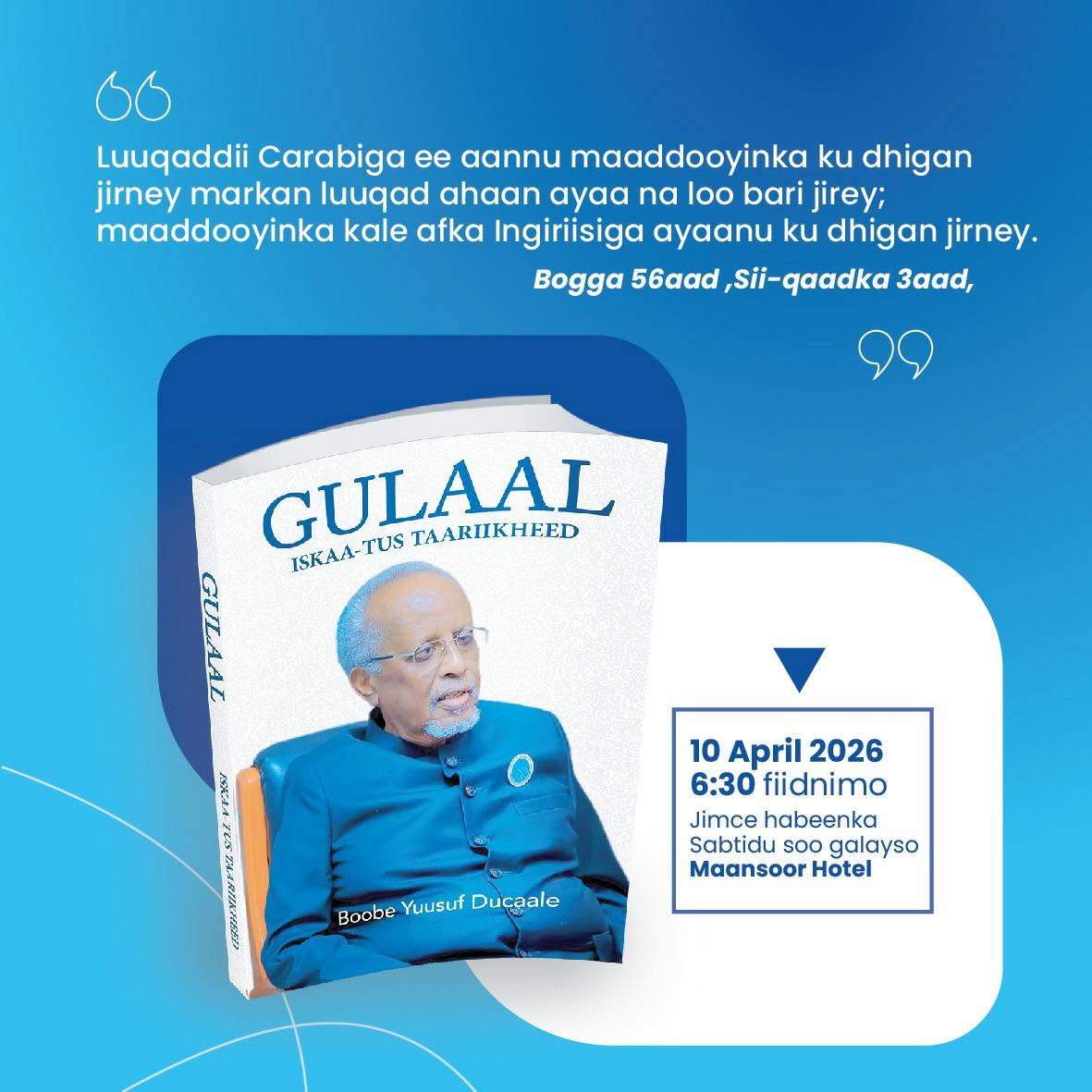
The last book he published was Gulaal: Iskaa-Tus Taariikheed (Gulaal: An Autobiographical Historical Account), in which he wrote about his own life, bringing his life’s story to a close.
May Allah have mercy on Boobe Yuusuf Duale.
—–
This article has been translated from Somali to English by Kaab TV. Original piece was published by Geeska in Somali. Read here.