


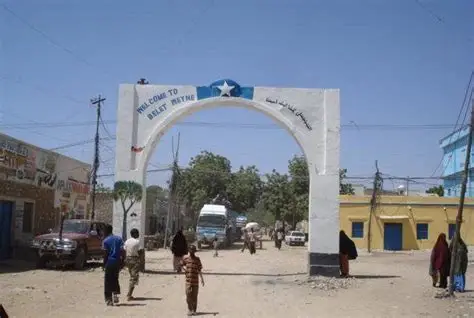


Beledweyne, has witnessed growing political tensions in recent weeks as residents, politicians, and community leaders remain divided over the upcoming Hirshabelle presidential election and the candidacy of incumbent President Ali Abdullahi Hussein, commonly known as Ali Gudlawe.
The dispute comes at a critical moment for Hirshabelle politics after the Justice and Solidarity Party (JSP) selected Gudlawe as its presidential candidate for the regional election.
The decision has sparked sharp disagreements among politicians, traditional elders, and sections of the public, particularly in Hiiraan.
On September 24, a large protest took place in Beledweyne, drawing community members, politicians, elders, and civil society representatives.
Demonstrators opposed efforts to proceed with the election process in Hiiraan before a broader political agreement is reached among key stakeholders.
The protest followed earlier rallies supporting Gudlawe and the JSP decision. On September 12, hundreds of residents joined a pro-Gudlawe demonstration in Beledweyne attended by regional and district officials who backed his candidacy and the continuation of the electoral process.
The competing demonstrations highlight deep divisions within the city over both the election process and the future leadership of Hirshabelle.
At the center of the dispute is not only Gudlawe’s candidacy but also broader questions about political representation, power-sharing, and decision-making within the state.
Critics argue that unresolved political grievances must be addressed before any election can move forward.
Traditional elders, politicians, and community leaders from the Hawadle clan have repeatedly stated that they will not accept an election in Hiiraan unless a political agreement is reached beforehand.
On September 17, Hawadle leaders called for the suspension of the ongoing electoral process, demanding a more inclusive framework based on consensus, representation, and agreed power-sharing arrangements. The position was reaffirmed again on September 22.
Supporters of the protests say the demonstrations are a legitimate way for Hiiraan residents to express their political concerns. They argue that holding an election without broad local consensus could deepen political divisions and create further instability.
Some political figures in Beledweyne have also called for dialogue involving the Federal Government of Somalia, Hirshabelle authorities, traditional elders, politicians, and civil society groups to address grievances related to Hiiraan’s role within the state administration.
Those backing this position believe that meaningful discussions on political representation and regional influence should take place before any election is held.
On the other hand, supporters of Gudlawe insist that the election should proceed under the existing framework. They argue that democratic competition, rather than political deadlock, should determine Hirshabelle’s next leader.
Several politicians from Hiiraan have publicly endorsed Gudlawe.
On September 14, former Hirshabelle President Ali Abdullahi Osoble and members of the Hawadle Supreme Political Council met Gudlawe in Mogadishu and expressed support for his political agenda, including participation in the planned electoral process.
Their backing underscores the fact that opinions within the Hawadle community itself are far from unified regarding both Gudlawe’s candidacy and the election process.
The political dispute has also reached the upper levels of the Hirshabelle administration. Hirshabelle Vice President Yusuf Ahmed Hagar, known as Dabageed, has publicly stated that he would not work with Gudlawe if the incumbent wins another term.
Dabageed has argued that the concerns of Hiiraan residents are not about leaving Hirshabelle but about what he described as the region being denied a fair opportunity to lead the state. His comments have added another layer to the growing political divide.
Analysts and local observers say continued protests could place additional pressure on the electoral process.
Opponents of the election are likely to use public demonstrations to highlight their objections, while supporters may continue pushing for the process to move forward as scheduled.
Without meaningful dialogue, the dispute could become more entrenched, with both sides mobilizing their supporters and maintaining competing political campaigns.
While peaceful demonstrations remain a legitimate form of political expression, there are concerns that rising tensions could create security challenges if rival groups clash.
Local leaders and authorities are therefore being urged to ensure that political disagreements do not escalate into confrontation.
The current situation in Beledweyne reflects two competing visions for Hirshabelle’s future. One side believes elections should be postponed until a comprehensive political agreement is reached regarding governance, representation, and power-sharing.
The other supports moving ahead with the election and allowing voters and political institutions to determine the state’s next leader.
Both sides say they are acting in the interests of Hirshabelle, but they differ sharply on how those goals should be achieved.
The debate also touches on a long-standing issue within Hirshabelle, which is made up of the Hiiraan and Middle Shabelle regions.
Questions surrounding political representation and the distribution of power between the two regions have remained a recurring source of political tension since the state’s formation.
The latest dispute in Beledweyne has once again brought those issues to the forefront. Many local leaders argue that resolving the current crisis will require more than deciding who becomes president.
Instead, they say the discussion must address broader concerns about governance, representation, and the future political structure of Hirshabelle.
As political tensions continue to rise, the coming weeks are expected to be crucial in determining whether dialogue and compromise can ease divisions or whether the dispute over the election process will further deepen existing political fault lines within the state.