

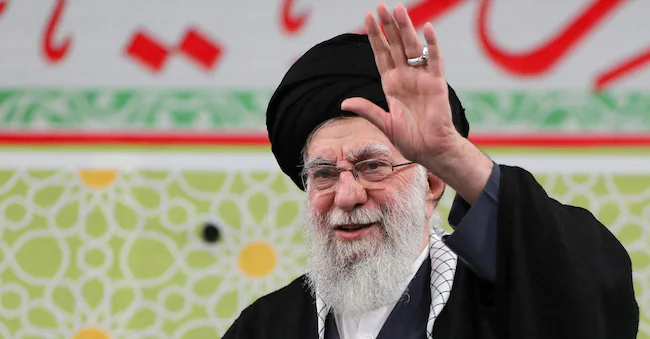
Tehran (Kaab TV) – The powerful leader of the Islamic Republic of Iran, Ayatollah Ali Khamenei, died yesterday, Saturday, February 28, 2026, following an airstrike targeting the city of Tehran, according to reports. His death came after aerial attacks by the U.S.–Israel coalition hit his residence.
Ali Hosseini Khamenei was born on April 19, 1939, in the city of Mashhad, Iran. He received his religious education in seminaries in Mashhad, Najaf, and Qom, where he became a close student of the leader of the Iranian Revolution, Ayatollah Ruhollah Khomeini. During the Iranian Revolution of 1978–1979, Khamenei was an active opponent of the Shah’s regime under Mohammad Reza Pahlavi, leading to multiple arrests and eventually his exile.
After the success of the revolution in 1979, Khamenei held several important positions. In 1981, he became the third president of Iran, a post he held until 1989, during the Iran–Iraq War. During his presidency, he strengthened ties with the Islamic Revolutionary Guard Corps (IRGC), which played an increasingly significant role in the country’s politics and security.
Following Khomeini’s death in 1989, Iran’s Assembly of Experts elected Khamenei as the country’s Supreme Leader, a position he held for more than 36 years. He became one of the longest-serving leaders in the Middle East and Iran’s longest-serving leader since Shah Mohammad Reza Pahlavi.
Domestically, Khamenei was known as a strong leader who reinforced the authority of the Supreme Leader’s office and significantly expanded the power of security and military institutions.
His tenure saw large-scale protests against the government, which were often met with force. In foreign affairs, he supported what came to be known as the “Axis of Resistance,” aligning with allied forces and militias in Syria, Iraq, Yemen, and Gaza.
Khamenei backed Iran’s civilian nuclear program and issued a religious decree (fatwa) banning weapons of mass destruction. He was a staunch opponent of Israel and Zionism, consistently expressing support for the Palestinian cause. These policies contributed to persistent tensions between Iran and Western countries, particularly the United States and Israel.
His death is expected to significantly alter the direction of Iranian politics and the regional balance of power.
While his supporters praise him as a defender of independence and revolutionary principles, his critics accuse him of political repression and human rights abuses. In any case, his legacy marks him as one of the most influential leaders in the Middle East in the 21st century.