


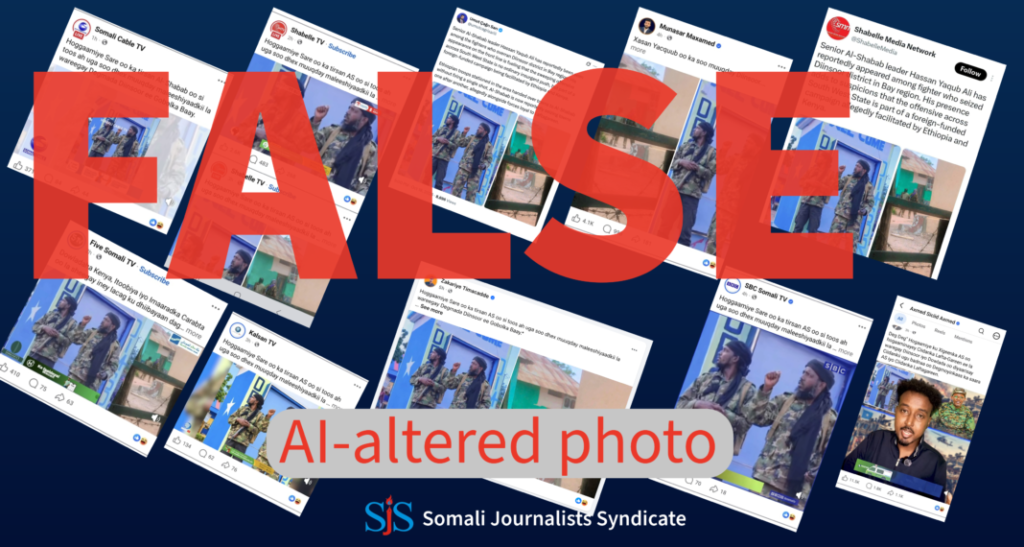


MOGADISHU, Somalia — On Sunday, 18 October 2026, an AI-altered photograph circulated widely across Somali news outlets, social media influencers, and online platforms, falsely claiming that senior Al-Shabaab leader Hassan Yaqub Ali appeared alongside fighters who seized Diinsoor town in the Bay region of Southwest State on 16 October following an offensive by pro-Abdiaziz Hassan Mohamed “Laftagareen” forces.
Several news sites and social media accounts amplified the post, further alleging that the conflict across Southwest State was part of a “foreign-funded campaign” facilitated by Ethiopia and Kenya. The manipulated images and claims accumulated thousands of views across Facebook, X (formerly Twitter), and YouTube, and were widely shared by accounts supportive of Aden Mohamed Nur (Aden Madobe) and the Somali Federal Government.
Following alerts from local journalists and citizens, the Somali Journalists Syndicate (SJS) conducted an open-source investigation to verify the images.
SJS Open-Source Investigation Findings
SJS determined that the viral image was a composite created through the sloppy application of AI editing tools, combining two separate sources:
-
Original Figures (2016 Al Jazeera Photo): The figures of the militants were taken from authentic photographs published by Al Jazeera English in November 2016, captured in central Somalia. In the original photo, Hassan Yaqub Ali—then described as Al-Shabaab’s governor in Galguduud—stood to the left of group spokesperson Ali Mohamud Raage. The manipulators repositioned the two men in black turbans and brightened their faces using AI tools.
Loading Viewer...
Political Conflict & Information Warfare Context
The circulation of the fake photo occurs against the backdrop of intense political and military conflict in Southwest State, where opposing factions frequently trade allegations of foreign interference and terrorist involvement:
-
March 2026: Somali Federal Government forces and local clan militias launched an offensive in Baidoa, forcing regional president Abdiaziz Laftagareen to flee. Laftagareen resigned on 30 March and accused the Federal Government of collaborating with Al-Shabaab.
-
June 2026: The Federal Government installed former Parliamentary Speaker Aden Mohamed Nur (Aden Madobe) as the new regional leader. Pro-Laftagareen forces launched counter-attacks on Baidoa, prompting reported Turkish fighter jet strikes near Baidoa to defend Federal forces and Madobe’s administration.
-
Rhetorical Escalation: Somali government officials and Madobe supporters repeatedly accuse pro-Laftagareen forces of integrating Al-Shabaab into their ranks—claims rejected by Laftagareen’s camp. Both sides actively use social and mainstream media to broadcast strong accusations and claim victories.
Civilian Toll and Risks of Synthetic Media
While propaganda spreads online, armed conflict in Southwest State continues to inflict severe harm on civilians. According to Médecins Sans Frontières (MSF), which supports Bay Regional Hospital, 234 civilian casualties—including 49 women and 27 children—have been recorded since 17 August. At least nine civilians have died, including a local journalist and a healthcare worker.
SJS warned that using AI-generated or AI-altered media to support serious allegations during an active armed conflict heightens public misinformation, deepens polarization, and risks inflaming hostilties on the ground.
SJS called on local media outlets, editors, and journalists to rigorously verify visual evidence before publication—especially regarding claims of foreign intervention or armed group involvement—and stressed the urgent need for Somali newsrooms to upgrade digital verification tools and media training to detect synthetic AI content.