


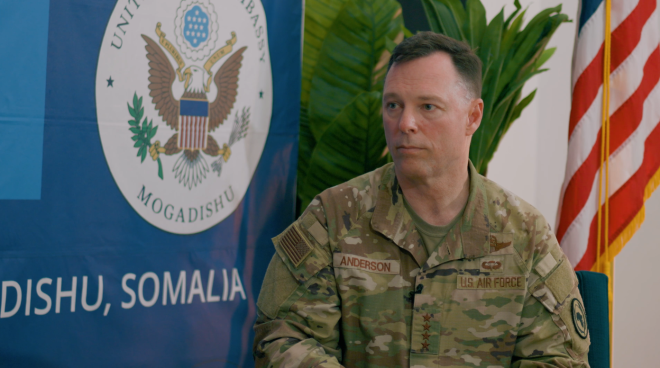


The commander of U.S. Africa Command (AFRICOM), General Dagvin R.M. Anderson, has dismissed claims that the United States is withdrawing from Somalia, insisting that Washington remains committed to supporting the country’s fight against terrorism while expecting Somali authorities to assume greater responsibility for their own security.
Speaking during his visit to Somalia, General Anderson said the United States has invested heavily in building Somalia’s counterterrorism capabilities and will continue to stand alongside the country as long as Somali leaders demonstrate sustained progress in strengthening national security institutions.
“The United States has not abandoned Somalia,” Anderson said. “We have been here for many years, and I believe we have been very effective.”
Danab Force Highlighted as a Major Success
Anderson pointed to the U.S.-trained Danab Special Forces Brigade as one of the most significant achievements of the long-running security partnership between Washington and Mogadishu.
“We helped build Danab, one of the most capable military units on the African continent. We are extremely proud of our role in developing this counterterrorism force. That mission has been accomplished. The force now exists and is ready to be employed against terrorist organizations,” he said.
However, he stressed that the next phase depends on Somalia itself.
“It is now Somalia’s responsibility to sustain, expand, and continue developing this force so it can independently confront terrorism,” Anderson added.
Washington Wants Somalia to Lead
The AFRICOM commander acknowledged that policymakers in Washington are increasingly questioning when Somalia will be able to take full ownership of its security after years of extensive American military assistance.
“There are people in Washington asking, ‘We’ve been here for many years. When will Somalia be able to independently manage these security challenges?'” he said.
According to Anderson, continued U.S. engagement will ultimately depend on Somalia’s ability to demonstrate political stability and sustained progress in assuming security responsibilities.
“If Somalia continues moving forward and its government takes the lead, we will remain engaged because we share common interests,” he said. “But if we do not see that progress, and political instability and internal disputes continue, it becomes much more difficult for us to justify a long-term commitment.”
Military Support Continues Despite Funding Concerns
Anderson’s remarks come amid growing debate over the future of U.S. involvement in Somalia following President Donald Trump’s return to office.
Although the administration has adopted a more cautious approach toward overseas commitments and has questioned long-term foreign spending, U.S. military cooperation with Somalia has continued.
The visit also comes at a time when Washington has informed the African Union that it does not intend to continue funding the United Nations Support Office in Somalia (UNSOS) beyond December 2026.
That decision has raised concerns over the future sustainability of the African Union Support and Stabilization Mission in Somalia (AUSSOM), which relies heavily on UN logistical support, including food, fuel, medical services, transport, and casualty evacuation.
Despite those funding concerns, the United States has reaffirmed that bilateral military cooperation—including intelligence sharing, training, air support, and counterterrorism operations—will continue.
U.S. Air Campaign Intensifies
While questions remain about the future of international funding for Somalia’s broader security architecture, U.S. military operations against militant groups have intensified.
According to data compiled by the New America Foundation, the United States has carried out a growing number of airstrikes against both Al-Shabaab and the ISIS affiliate in Somalia since President Trump returned to office.
The pace of operations has already surpassed the combined number of strikes conducted during the administrations of George W. Bush, Barack Obama, and Joe Biden over comparable periods, placing the current campaign on course to exceed the 219 airstrikes conducted during Trump’s first term.
Most of the operations have targeted Al-Shabaab, the al-Qaeda-linked insurgent group that has been fighting the Somali government since 2007 and continues to control parts of southern and central Somalia, as well as ISIS militants operating in the mountainous regions of northeastern Somalia.
A Long-Term Security Partnership
Over the past two decades, the United States has invested billions of dollars in Somalia through military training, intelligence cooperation, counterterrorism assistance, humanitarian aid, and institutional capacity building.
Washington remains one of Somalia’s most important security partners as the Federal Government seeks to weaken extremist groups and gradually assume full responsibility for national security.
General Anderson’s visit underscores a dual message from Washington: the United States remains committed to helping Somalia combat terrorism, but future support will increasingly depend on measurable progress toward political stability, security sector reform, and Somalia’s ability to independently lead and sustain its own security operations.