


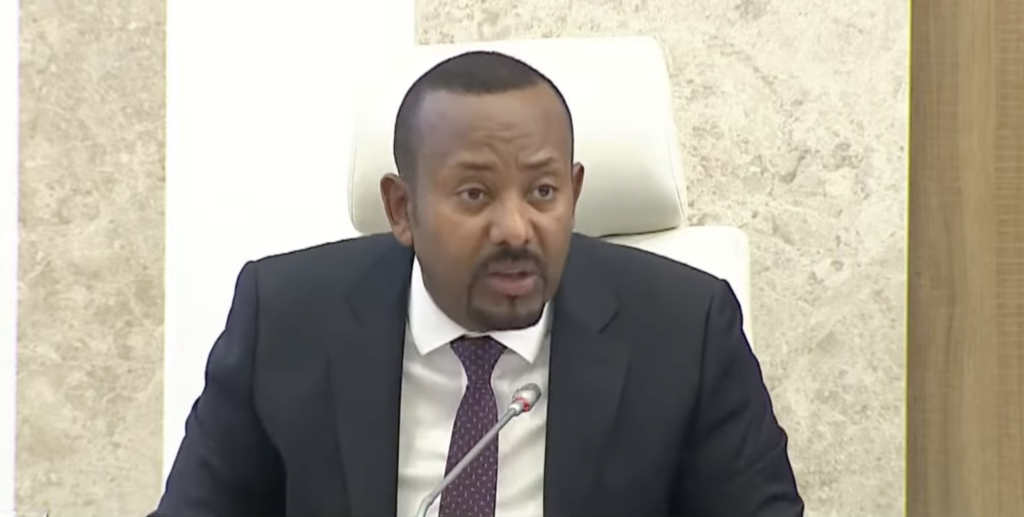


ADDIS ABABA, Ethiopia (Kaab TV) — Ethiopian Prime Minister Abiy Ahmed Ali on Tuesday presented the federal government’s six-month performance report for the 2018 Ethiopian fiscal year during the 10th Regular Session of the House of Peoples’ Representatives, outlining progress, challenges, and key national priorities.
Addressing lawmakers, Abiy said Ethiopia’s ongoing peace challenges stem from a continued reliance on force, political betrayal, and fears surrounding the country’s economic and social transformation.
He stressed that the people of Tigray seek peace and development and must become full participants in Ethiopia’s political process.
On the disputed Wolkait area, the prime minister said no further displacement should occur, displaced residents must be allowed to return to their homes, and local communities should be given the right to determine their own future.
Democracy, Dialogue, and Regional Affairs
Abiy reaffirmed the government’s commitment to holding peaceful, fair, and inclusive elections, stating that the next parliament is expected to reflect Ethiopia’s diversity.
He said the National Dialogue process remains the preferred approach for resolving long-standing political disputes.
Turning to foreign affairs, Abiy described the Horn of Africa as deeply interconnected but fragile, citing regional rivalries, external interference, and shared water resources as key challenges.
He said Ethiopia continues to pursue regional diplomatic efforts aimed at promoting stability and cooperation.
Sea Access Remarks
Speaking on Ethiopia’s long-standing ambition to access the sea, Abiy said regional challenges should be addressed through dialogue and cooperation. He argued that Ethiopia’s need for sea access is a matter of natural justice.
“Regarding the Red Sea, my position is very clear,” Abiy told parliament. “Ethiopia needs access to the sea. Those who argue that Ethiopia does not need or does not deserve sea access are violating a natural law.”
He compared Ethiopia’s relationship with the Red Sea to a natural and enduring bond, drawing loud applause from lawmakers.
Abiy noted that the distance from Mogadishu in Somalia to Massawa in Eritrea spans about 5,000 kilometers of coastline, which he said is sufficient for the populations living along it.
He added that Somalia, with a population of about 20 million, and Djibouti, with fewer than one million people, both have extensive coastlines, while Ethiopia, with more than 120 million people, remains landlocked and seeks a modest stretch of coastline.
“If this is not justice, then there is no justice in the world,” he said.
Economic Performance and Digital Expansion
Abiy reported that Ethiopia’s macroeconomic reform agenda remains focused on stabilization, diversified growth, and debt reduction.
Abiy said economic growth is projected at 10.2 percent, in line with International Monetary Fund estimates, noting that Ethiopia continues to grow without oil resources.
Highlighting progress in connectivity and digital services, Abiy said Ethiopian Airlines transported 10.7 million passengers in six months.
Mobile subscriptions reached more than 97 million, while mobile money users rose to 58 million.
He added that 5G internet services are expected to launch in 30 cities and that Ethiopia is establishing what he described as the world’s second artificial intelligence university.
The Prime Minister said the expansion of mobile connectivity has contributed to economic empowerment across the country.
Production, Revenue, and Investment
In the production and trade sectors, the government recorded the harvest of 999 million quintals of crops over six months.
Manufacturing capacity utilization reached 66.3 percent, while import substitution saved USD 3.4 billion. Merchandise exports generated USD 5.1 billion during the same period.
According to the report, the government collected 709 billion birr in revenue and attracted USD 2.3 billion in foreign direct investment over six months.
Abiy said no new commercial dollar-denominated loans have been taken since the reform program began.
Mining, Housing, and GERD
Mining revenue increased by 30 percent, with iron production rising by 36 percent and cement production by 28 percent, reflecting continued housing development and urban expansion.
On the Grand Ethiopian Renaissance Dam (GERD), Abiy reiterated that the project was completed without foreign aid or loans, saying it was fully financed by Ethiopians as a national endeavor.