


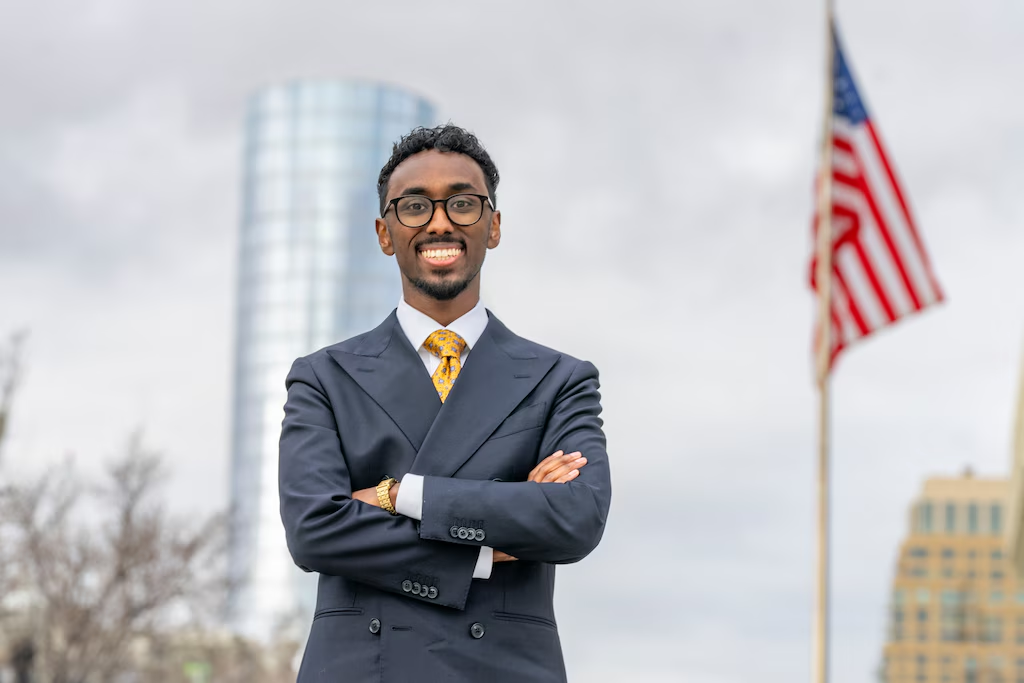


Mogadishu (Kaab TV) – Liban Mohamed, a 27-year-old son of Somali immigrants, is heading into a high-stakes Utah Democratic congressional primary this June after narrowly winning the state party convention last month with 51% of the vote — a result widely viewed as an upset for the party’s political establishment.
The rapid rise of a previously little-known progressive candidate in Utah has exposed growing divisions within the state Democratic Party, reflecting a broader national struggle between the party’s moderate establishment and its younger, more progressive wing.
In the race for Utah’s 1st Congressional District, Mohamed defeated former congressman and former Salt Lake County mayor Ben McAdams, a well-funded candidate he will face again on the primary ballot. Under Utah law, candidates can qualify for the primary either by winning support at the party convention or by collecting enough signatures. All four candidates — Mohamed, McAdams, state senator Nate Blouin, and attorney Michael Farrell — qualified through signatures.
Mohamed, who previously worked in public policy roles at Meta and TikTok, said his rise reflects growing frustration among voters who feel working-class and immigrant communities have long been overlooked.
“The definition of insanity is doing the same thing over and over again while expecting different results,” Mohamed said. “Utahns are ready to take a chance on hope instead of settling for the certainty of the status quo.”
Born in a small town in Utah, Mohamed often draws parallels between his family’s refugee journey and the history of the state’s Latter-day Saint, or Mormon, community, which experienced religious persecution throughout American history.
“In many ways, people here see themselves as refugees too,” Mohamed said. “So when they see families coming from places like where mine came from, seeking asylum, they have compassion and understanding.”
His victory also came amid controversy surrounding several other candidates in the race. Blouin, once considered a leading contender and a former staffer for Bernie Sanders, faced backlash after old online posts resurfaced containing jokes about sexual assault, slurs, and comments criticizing members of the Mormon faith. Blouin later apologized and told convention delegates he was confronting and learning from his past mistakes. Meanwhile, Salt Lake City council member Eva Lopez Chavez faced allegations of unwanted sexual advances from multiple individuals, claims she has denied. She was eliminated in the first round of voting.
Mohamed’s rise also arrives at a pivotal moment in Utah politics following years of legal battles led by a nonpartisan group seeking to reinstate Proposition 4, an anti-gerrymandering initiative. Earlier this year, the state Supreme Court struck down Republican-drawn congressional maps in a landmark ruling, leading to the redrawing of the 1st Congressional District into a more compact, Democratic-leaning seat centered around Salt Lake County — an area that is diverse, youthful, and largely progressive.
“This district is not what most people imagine,” Mohamed said during a phone interview. “We have 60,000 refugees, 60,000 Muslims, and nearly 120,000 members of the Latinx community.”
His candidacy also reflects growing Democratic momentum nationwide, with some figures in Utah’s Democratic establishment describing it as another “Mamdani moment.” Despite his convention victory, however, Mohamed remains an underdog in the race. Current polling places him in the single digits, while McAdams and Blouin maintain double-digit support and significant fundraising advantages.
For Mohamed, the decision to run came during a renewed immigration crackdown under the second Trump administration and a period of heightened tensions involving Somali communities in the Midwest. In Minnesota, federal immigration operations intensified under what officials called Operation Metro Surge, a large-scale enforcement effort that deployed thousands of agents to the Minneapolis–Saint Paul area and drew national outrage following several deadly encounters involving federal officers.
Trump had repeatedly targeted Ilhan Omar, the only Somali American member of Congress, amplifying rhetoric that many Somali Americans viewed as hostile. At the same time, online accusations of fraud against members of the Somali community circulated widely through right-wing YouTubers, further escalating tensions.
“I had to ask myself whether I should stand up and fight back with everything I had, knowing it could bring more attention to our district and possibly accelerate ICE activity here,” Mohamed said. “That moment made me realize what this campaign is truly about — finding leadership that is courageous enough to fight when necessary, but wise enough to protect the community.”
When Mohamed announced his candidacy, he said the backlash was immediate.
“I received more than 40,000 anti-immigrant and Islamophobic messages,” he said. “Some people were shocked — maybe even afraid — that a 27-year-old Somali American, the son of immigrants, in Utah of all places, believed he belonged in Congress.”
Despite the hostility, Mohamed insisted that Utah itself is not the issue, but rather the state’s political system.
“Our politics and representation do not reflect the true values of the people here,” he said.
With the primary approaching quickly, Mohamed hopes a broad coalition of voters can carry his campaign to an upset victory.
“We have first-time delegates, young people, refugees, immigrants, working-class families, and longtime community members organizing together to make this happen,” he said. “People continue to underestimate us, but in the end, community always prevails. Elections are decided by voters — not by the amount of money spent.”