

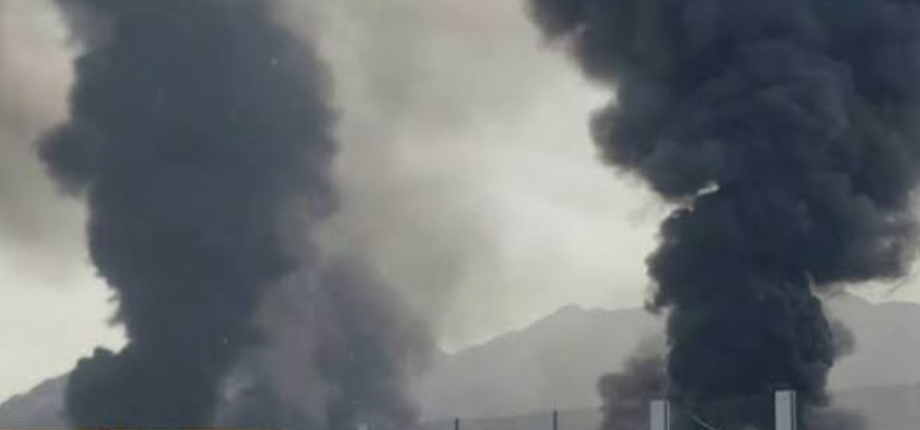

The military confrontation between the United States and Iran intensified on Sunday as both sides exchanged another round of large-scale strikes, with attacks spreading across the Gulf region and raising fears of a wider regional war.
Iran claimed responsibility for missile and drone attacks targeting U.S. military assets and strategic locations in Jordan, Bahrain, Kuwait, Qatar, and Oman, while the United Arab Emirates said its air defense systems intercepted several Iranian ballistic missiles and suicide drones before they reached their intended targets.
Qatar confirmed it had come under attack by Iranian ballistic missiles, with at least three people injured after debris from intercepted missiles fell in populated areas.
Following the attack, Qatar’s Ministry of Transport ordered all commercial and recreational vessels to temporarily suspend navigation and maritime activities until further notice, citing public safety concerns.

The directive applies to commercial ships, fishing boats, recreational vessels, and jet skis.
The Qatari government strongly condemned the missile strikes, describing them as “a flagrant violation of Qatar’s sovereignty and territorial integrity” and a serious breach of international law.
“Qatar holds the Islamic Republic of Iran fully legally responsible for these aggressions and all their repercussions and consequences,” the Foreign Ministry said, adding that the attacks represent a dangerous escalation that threatens regional stability and undermines ongoing diplomatic efforts.
Meanwhile, the U.S. military said it had carried out one of its largest air campaigns against Iran, striking more than 140 military targets across at least nine cities in five provinces.
Explosions were reported in the southern Iranian ports of Bandar Abbas, Sirik, Chabahar, Bandar-e Deyr, Jask, and Asaluyeh, with the strikes reportedly targeting missile bases, drone facilities, weapons depots, command centers, communications infrastructure, and other military installations.
The latest exchange marks the third major wave of U.S. strikes this week, bringing the total number of reported American targets inside Iran to more than 300, according to U.S. military officials.
Iran responded by announcing attacks on U.S. military assets across five countries in the Gulf region and declared that the Strait of Hormuz had been closed.
The waterway is one of the world’s most important oil shipping routes, carrying roughly one-fifth of global seaborne oil exports, raising fresh concerns over energy markets and global trade.
Iranian Parliament Speaker and chief negotiator Mohammad Bagher Ghalibaf said Tehran no longer considers previous understandings with Washington to be binding.

“The era of one-sided agreements is over,” Ghalibaf declared, signaling that Iran believes the existing memorandum of understanding has effectively collapsed.
His remarks came after U.S. President Donald Trump stated that the ceasefire between the two countries was “over,” although he said American negotiators would remain available for talks.
The latest escalation follows growing disputes over the implementation of the memorandum of understanding signed between Washington and Tehran.
Iranian officials argue that several provisions have already been violated, pointing to renewed U.S. sanctions imposed earlier this week despite commitments to avoid additional punitive measures during negotiations.
The continuing exchange of missile strikes, drone attacks, and air raids has heightened international fears that the conflict could expand into a broader regional war involving multiple Gulf states, while diplomatic efforts to restore the ceasefire appear increasingly fragile.