


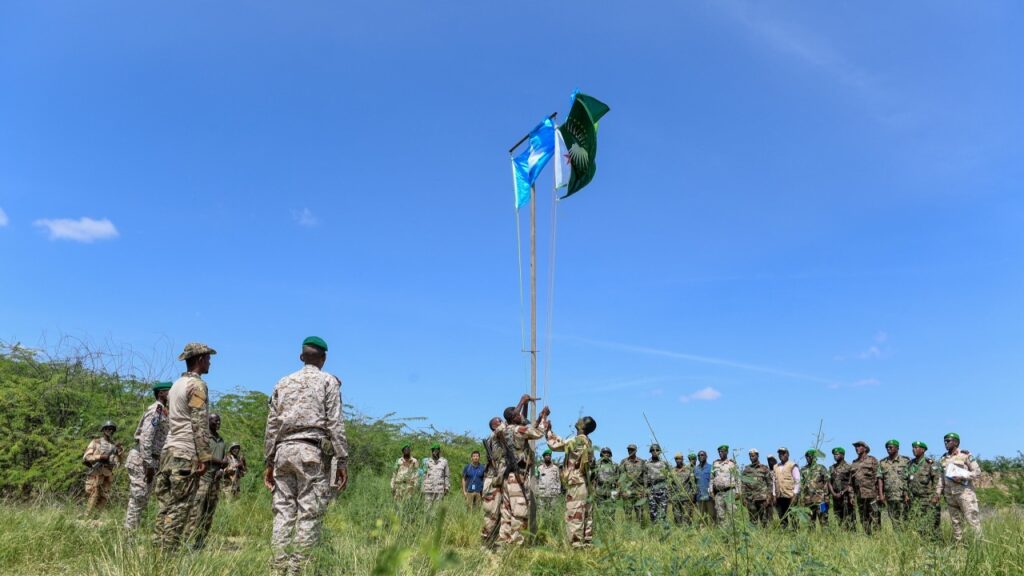


MOGADISHU, Somalia — Earlier this year, the parade ground at AU’s Halane military compound in Mogadishu took on a decidedly ceremonial air — Somali flags fluttering beneath the scorching coastal sun, AU officers standing to attention as brass bands played to mark what many described as a new chapter in Somalia’s protracted conflict.
After nearly two decades of African Union peacekeeping, the last contingents of the African Union Transition Mission in Somalia (ATMIS) lowered their flags and prepared to leave.
In their place stood a new banner: AUSSOM — the African Union Support and Stabilisation Mission in Somalia.
On paper, it marked the beginning of Somalia’s long-promised self-reliance in security affairs. In practice, the transition has exposed the uneasy truth at the heart of Somalia’s recovery: the country’s ability to sustain peace may depend less on the number of troops and more on whether it has built a state worth defending.
A Transition of Necessity, Not Triumph
ATMIS — and its predecessor, AMISOM — had for years served as both shield and scaffolding.
Its African troops, funded largely by the European Union and the United States, absorbed the shock of al-Shabab’s insurgency and helped keep Mogadishu’s fragile institutions upright. But donor fatigue and shifting global priorities — from Ukraine to the Sahel — forced an inevitable question: how long could foreign troops fight a Somali war?
In 2024, that question found its answer. AUSSOM’s creation, designed as a leaner and politically lighter successor to ATMIS, was less a choice than a necessity.
The new mission’s mandate is advisory, not combat-driven, its footprint far smaller, and its emphasis on stabilisation rather than direct confrontation.
“It’s a handover with a stopwatch,” said a senior international security advisor in Nairobi, requesting anonymity to speak candidly.
“AUSSOM was created to exit gracefully, not to fight indefinitely.”
An Army in Search of a State
For Somalia’s government, the shift from ATMIS to AUSSOM is both an opportunity and a risk.
Officials in Mogadishu portray it as a milestone of sovereignty — proof that the country can now lead its own security. Yet across much of rural Somalia, reality tells a harsher story.
The Somali National Army (SNA) has improved markedly since the chaotic 2010s, when clan loyalties and payroll corruption hollowed out its ranks.
Training programs led by Turkey and the United States have produced elite units like the Gorgor and Danab commandos, while Washington has reinstated drone strikes and special operations support, and regional partners have strengthened the country’s logistical backbone.
Still, the army remains fragmented, under-equipped, and politically entangled.
Salaries often arrive late. Local militias — nominally under federal command — answer to regional presidents or clan elders. Officers in federal states complain privately that orders from Mogadishu are often ignored or filtered through patronage networks.
“The SNA fights bravely,” said a retired Somali colonel in Mogadishu.
“But bravery doesn’t win long wars — structure does. And that’s what we still lack.”
The Vacuum Problem
AUSSOM’s creation coincided with a series of territorial reversals that exposed the fragility of Somalia’s gains.
In the months leading up to the transition, al-Shabab retook pockets of territory in Galmudug and Hirshabelle. Analysts attribute these losses to a premature drawdown of ATMIS troops, leaving untested Somali forces overstretched and poorly supplied.
The new mission’s “light footprint” approach — focused on mentoring and political support — was meant to empower Somali institutions. Instead, it has revealed their limits.
AUSSOM lacks funds, the robust logistical chains, airlift capacity, and unified command that once defined ATMIS.
Coordination between AUSSOM and Somali units remains ad-hoc, dependent on donor-funded contractors and bilateral relationships rather than a cohesive national plan.
“The symbolism of transition outpaced the substance,” said a Horn of Africa analyst based in Nairobi.
“Somalia got sovereignty on paper before it got capacity on the ground.”
Politics Behind the Frontlines
Every battle in Somalia is also a political negotiation.
The country’s federal system — a patchwork of autonomous regions — means no military success is purely national.
In Jubaland, local forces maintain their own command chain. In Puntland, tensions with Mogadishu over resource control have repeatedly stalled joint operations.
That fragmentation weakens not just the fight against al-Shabab but the very legitimacy of the federal state. AUSSOM’s mandate, though military in form, is deeply political in function — to broker cooperation where mistrust runs deep.
“It’s a security mission trapped in a political puzzle,” said a senior AU official involved in the transition.
“You can train soldiers all you want, but if the politics doesn’t hold, they’re fighting for nothing.”
The Al-Shabab Factor
Despite sustained airstrikes and local offensives, the al-Qaeda linked extremist group, al-Shabab remains far more organized in much of rural Somalia than the state. It operates courts, collects taxes, and provides a crude form of governance in areas where the state is absent.
Intelligence reports indicate that the group has diversified its tactics — expanding into financial crime, cyber operations, and cross-border smuggling. Its resilience underscores a grim paradox: as foreign missions scale down, al-Shabab’s staying power grows not by strength of arms, but by the weakness of governance.
The militants have learned to avoid costly confrontations, instead using targeted assassinations, ambushes, and propaganda to exploit political divisions. In a recent statement, the group mocked the AUSSOM transition as “the changing of uniforms, not reality.”
Metrics of Success — or Failure
Diplomats in Mogadishu say the coming 18 months will be decisive. The benchmarks are clear but unforgiving:
Can Somali forces independently secure key population centers for at least six consecutive months?
Are defense salaries being paid transparently, without donor oversight?
Can AUSSOM operate effectively without emergency funding from the EU or the U.S.?
Most crucially, can local administrations deliver basic services faster than al-Shabab can re-infiltrate?
If the answer to most of these remains “no,” the transition risks becoming a managed retreat rather than a step toward sovereignty.
Regional and Strategic Ripples
Somalia’s experiment with AUSSOM is being watched closely across the Horn.
The withdrawal of large foreign forces also reorders power dynamics within Somalia’s elite. With fewer international boots on the ground, foreign policy leverage shifts — from military partners to financial ones.
Turkey, the UAE, and Qatar are positioning themselves as primary security and infrastructure patrons, each with distinct agendas that blur the line between assistance and influence.
As one diplomat put it: “AUSSOM is not just a military mission. It’s a geopolitical mirror reflecting who still believes in Somalia — and who is quietly giving up.”
Abdi Guled is a Horn of Africa analyst and journalist with a focus on political risk, armed groups, and geostrategic competition in fragile states.