

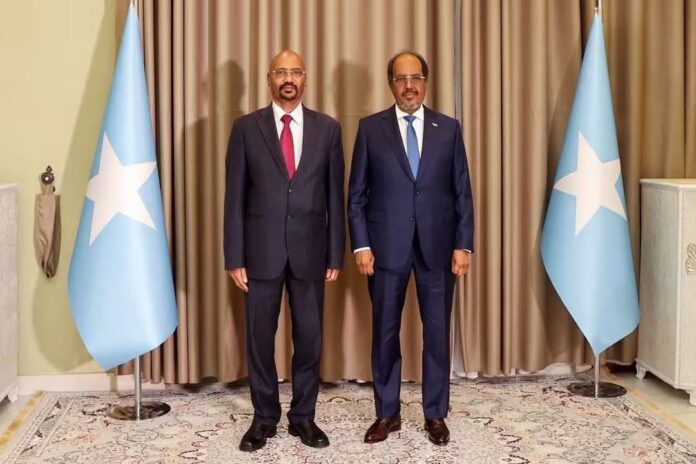

Former Ethiopian Ambassador to Somalia Suleiman Dedefo has argued that efforts to mediate the country’s political disputes cannot succeed without Ethiopia’s involvement in the dialogue and reconciliation process.
Dedefo said Ethiopia had played a longstanding role in Somalia’s political affairs, security and reconciliation efforts, arguing that Addis Ababa’s historical involvement should be recognised in any initiative aimed at resolving the country’s internal disputes.
His remarks come as Somalia faces deepening political disagreements between the Federal Government, federal member states and opposition figures over elections, constitutional amendments, power-sharing arrangements and the country’s political future.
The former ambassador pointed to Ethiopia’s involvement in previous reconciliation initiatives, citing conferences and negotiations hosted in Addis Ababa during periods when Somalia was experiencing conflict and political divisions.
He also highlighted Ethiopia’s role in hosting Somalis displaced by conflict and providing assistance to communities affected by insecurity and humanitarian crises.
Dedefo said the two countries shared a long history and described Somalia as an important neighbour whose stability was closely linked to peace and security across the Horn of Africa.
He also referred to Ethiopia’s historical contribution to the Somali people, claiming that the country had made significant sacrifices in support of their liberation.
He added that Addis Ababa remained supportive of an independent Somalia seeking to restore its position in the international community.
His comments reflect Ethiopia’s perspective on its relationship with Somalia and its role in the country’s political and security affairs.
However, Ethiopia’s involvement has also been a source of controversy, particularly over allegations of interference in Somalia’s internal affairs, the deployment of Ethiopian troops and Addis Ababa’s strategic interests in the region.
Dedefo also raised concerns over what he described as the presence of foreign forces in Somalia seeking to undermine Ethiopia’s security. He warned that such activities could affect bilateral relations and threaten stability across the region.
His remarks highlight Ethiopia’s longstanding concerns about armed groups and activities it considers threats to its national security.
They also come amid wider disagreements between Mogadishu and Addis Ababa over sovereignty, military deployments and competing strategic interests.
Relations between Somalia and Ethiopia have faced significant strain in recent years, particularly following Ethiopia’s memorandum of understanding with Somaliland.
Somalia strongly rejected the agreement, describing it as a violation of its sovereignty and territorial integrity.
Other sensitive issues include Ethiopia’s pursuit of maritime access, the presence of Ethiopian troops in Somalia, security cooperation and the influence of regional powers on Somalia’s domestic political affairs.
Although diplomatic initiatives have sought to ease tensions between the two countries, disagreements over security, sovereignty and strategic interests remain important factors shaping their relationship.
Dedefo’s remarks have once again brought Ethiopia’s potential role in mediating Somalia’s political disputes into focus.
While some may view Addis Ababa’s historical involvement and regional influence as important to reconciliation efforts, others remain concerned about its strategic interests and previous disputes with Mogadishu.
These differing perspectives raise questions about the extent to which Ethiopia could participate in a mediation process while earning the confidence of Somalia’s competing political stakeholders.