

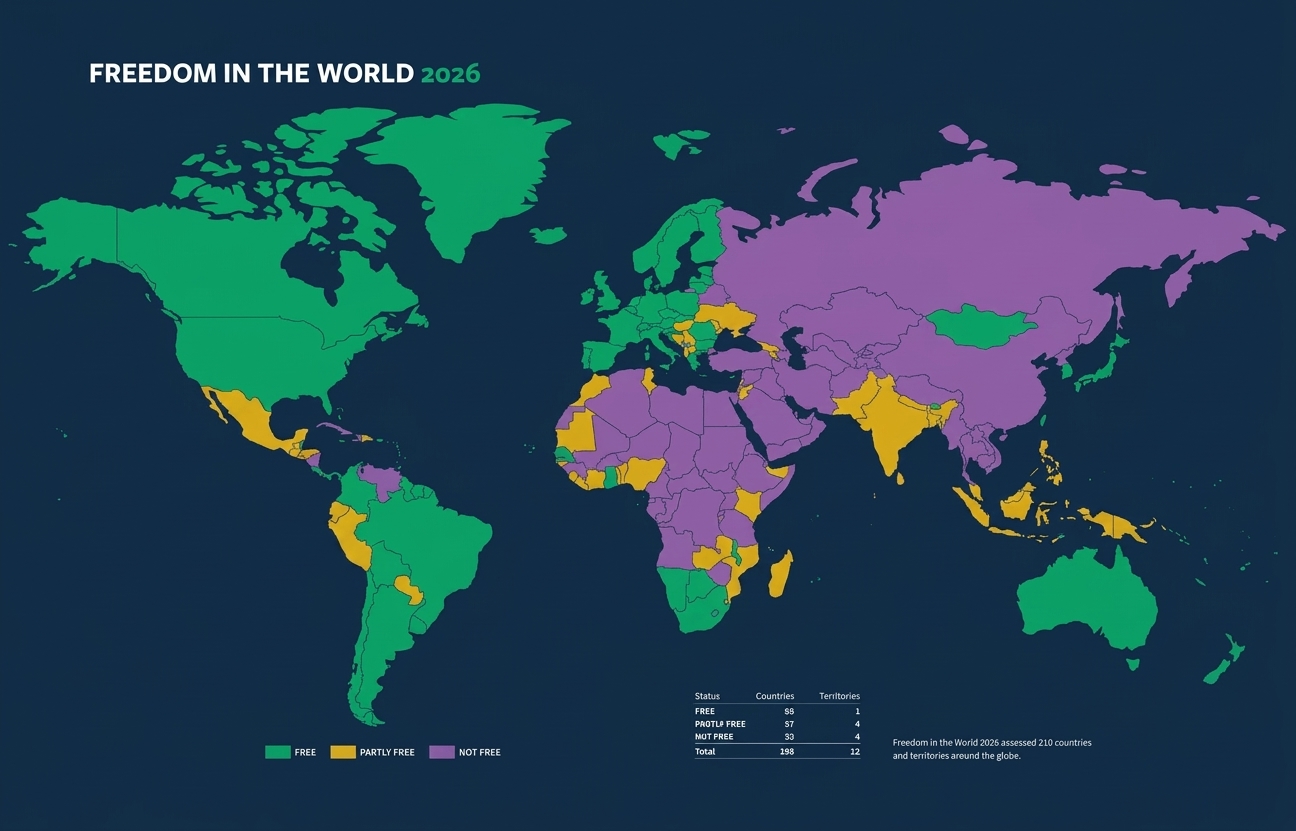

The new report by Freedom House assessing the state of freedoms and political rights across the countries of the world has revealed a significant disparity between Somalia and Somaliland, once again igniting debate regarding the level of democracy, freedom of speech, and the political climate in both regions.
The Freedom in the World 2026 report awarded Somalia 8 out of 100 points, classifying it as Not Free, whereas Somaliland received 47 points and was designated as Partly Free.
This assessment indicates that Freedom House evaluated Somalia and Somaliland separately, although Somaliland’s political status remains contested regarding international recognition.
A map published on the X (formerly Twitter) account of the U.S. Embassy in Australia illustrates how the world is categorized according to levels of freedom, showcasing countries by their political rights and civil liberties conditions.
The embassy’s statement emphasized the importance of freedom, particularly the ability of citizens to speak, vote, and freely express their opinions.
However, it is vital to distinguish between the embassy’s message and the Freedom House assessment, as the scores for Somalia and Somaliland originated from the organization’s report.
Freedom House noted that Somalia continues to face profound challenges regarding state institution-building, security, elections, and the protection of human rights.
The report pointed out that Somalia has yet to conduct a direct national election, and that the nation’s politics are heavily influenced by clan fragmentation and disputes between the federal government and regional member states.
It was also noted that the federal government does not exert full control over all national territory, with various areas remaining under the control of Al-Shabaab and other political authorities.
Insecurity, human rights violations, and obstacles confronting press freedom are among the factors that negatively impacted Somalia’s score.
Regarding Somaliland, Freedom House stated that its political system has allowed opposing political parties to peacefully transfer power through electoral mechanisms.
The organization also noted the presence of political competition and party participation, while highlighting that elections have frequently been delayed and that restrictions affecting civil liberties persist.
The report further addressed pressures faced by journalists and individuals expressing political views, discrimination encountered by minority clans, and issues concerning violence against women.
Consequently, the score of 47 points does not imply that Somaliland is classified as fully free, but rather places it within the partly free category.
The primary question arising from this assessment is whether Somaliland being specifically evaluated in the report implies international recognition as an independent state.
The answer is no. Freedom House explicitly stated that its evaluations pertain to freedom conditions within a given territory or region, with contested territories occasionally evaluated separately.
The report on Somaliland even noted that the name Somaliland was utilized for territorial assessment purposes, which is distinct from a formal diplomatic recognition decision.
Therefore, the Freedom House assessment cannot be interpreted as a decision by the United States or any international body recognizing Somaliland’s independence.
This divergent scoring renews the ongoing debate over why Somalia continues to struggle with establishing a functioning government, a direct electoral system, an independent judiciary, and the protection of citizens’ rights.
Conversely, Somaliland faces scrutiny regarding election delays, media freedom, the protection of minority rights, and the strengthening of state institutions.
Both entities confront distinct challenges, and this assessment demonstrates that political progress and the preservation of freedoms cannot be measured solely by the existence of a government or administration, but also by how citizens participate in politics and how their rights are safeguarded.
Ultimately, the Freedom House 2026 report awarded Somalia 8/100 and Somaliland 47/100.
These figures represent evaluations conducted by an independent organization tracking global freedoms, rather than a legal or diplomatic determination reflecting statehood recognition.