

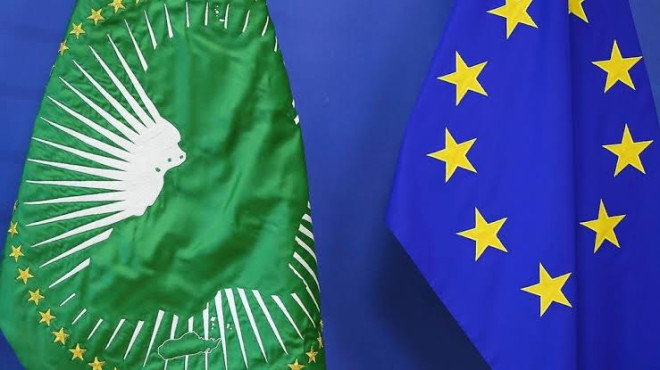

The African Union and the European Union have expressed grave concern over the financial and operational challenges confronting the African Union Support and Stabilization Mission in Somalia (AUSSOM), warning that these difficulties could jeopardize the gains achieved in the war against Al-Shabaab and Somalia’s roadmap toward assuming national security responsibilities.
This concern was highlighted during a consultative meeting held on November 6, 2026, in Addis Ababa, Ethiopia, convening the African Union Peace and Security Council and the European Union Political and Security Committee.
The meeting addressed continental security dynamics, placing specific emphasis on the future of AUSSOM, support for Somali security forces, and overarching challenges facing African Union peacekeeping operations.
The joint communiqué issued following the session noted that both sides commended the Federal Government of Somalia, AUSSOM personnel, and troop-contributing countries, acknowledging the substantive progress registered in counter-Al-Shabaab operations. Nevertheless, they cautioned that funding deficits and operational obstacles risk undermining the continuity of security engagements.
AUSSOM plays an indispensable role in backing Somali state security forces—particularly in anti-Al-Shabaab operations, securing vital infrastructure, and supporting stabilization initiatives across cleared territories.
However, executing missions of this scale necessitates continuous funding and logistical services, encompassing fuel, rations, transport, communications equipment, medical provisions, and sustained field support for deployed units.
When these provisions diminish or stall, the mission’s operational capacity to fully discharge its mandate is severely impaired. This dynamic underscores why the African Union and European Union voiced deep concern regarding the preservation of prior security milestones.
Both entities specifically underscored the necessity of securing adequate, predictable, and sustainable financing to insulate the mission from erratic funding streams.
A paramount driver of this apprehension centers on the future of logistical support rendered by the United Nations to AUSSOM through the United Nations Support Office in Somalia (UNSOS).
UNSOS provides mission-critical sustainment underpinning troop presence and mobility, including transport, fuel, rations, medical care, and auxiliary logistical services.
According to United Nations data, UNSOS logistics packages support approximately 11,826 military and police personnel serving under AUSSOM, alongside supporting Somali forces engaged in joint or coordinated operations with the mission.
A Reuters report published on September 18, 2026, disclosed that the United States approved a 12-month phased reduction in UNSOS logistical support, with the drawdown process projected to commence in January 2027.
This development raises pressing questions regarding which actors will absorb support responsibilities and where the requisite funding to cover operational shortfalls will be mobilized.
The curtailment of UNSOS support transcends mere budgetary accounting; it directly impacts the operational readiness of AUSSOM battalions.
In the absence of a comprehensive contingency transition plan, acute vulnerabilities will emerge regarding field supply lines, vehicular mobility, casualty evacuation, and forward-base garrisoning.
Furthermore, certain combat operations risk facing delays or experiencing a diminished capacity to reinforce Somali national forces.
The September Reuters reporting indicated that the planned 12-month window affords stakeholders an opportunity to identify alternative financing and logistical channels, though underlying uncertainty regarding the mission’s trajectory persists.
The African Union and European Union insisted that the Federal Government of Somalia spearhead an assessment quantifying the operational impact of UNSOS support reductions on national security and the broader troop transition architecture.
This evaluation remains vital to delineating operational sectors where Somali forces can independently project security versus areas still necessitating AUSSOM reinforcement and international partner assistance.
Additionally, Mogadishu is expected to institute a clear, sustainable roadmap governing force financing, remuneration, materiel procurement, and the development of enduring indigenous military capabilities.
If security transition milestones are executed without adequate financial and materiel resourcing, Somalia will face immense hurdles in smoothly assuming full security responsibilities.
**Warnings Coinciding with Foreign Force Reductions**
The joint concerns of both organizations also coincide with major structural realignments governing international military presences in Somalia.
An Associated Press dispatch published on November 3, 2026, reported that Uganda initiated the retrograde of select military contingents stationed in Somalia under bilateral frameworks, with a comprehensive withdrawal timeline extending through the end of 2027 for all Ugandan personnel, including AUSSOM elements.
The report also noted that AUSSOM is planning to assume control of four strategic bases encircling Mogadishu and Lower Shabelle: Sabiid-Anole, Bariire, Awdheegle, and Bulonagad.
It remains essential to distinguish between Ugandan forces deployed under bilateral pacts and those integrated into AUSSOM. Although distinct, realignments affecting Ugandan forces carry broader systemic implications for overall operational stability.
Consequently, force synchronization, base transfer scheduling, and sustainable financing emerge as absolute prerequisites for regional stability.
Beyond articulating concerns, both organizations advocated for diversified funding architectures to sustain African Union peace operations.
They highlighted the critical utility of mandatory United Nations assessed contributions—operationalized through UN Security Council Resolution 2719 (2023)—alongside the African Union Peace Fund and expanded international partner contributions.
Resolution 2719 establishes a foundational framework enabling select African Union peace operations to access UN-assessed contributions under strict compliance and oversight mechanisms.
These measures reflect a concerted push by both organizations to eliminate over-reliance on volatile, voluntary financing pledges.
The meeting communiqué reaffirmed the unwavering support of the African Union and European Union for Somalia’s sovereignty, territorial integrity, political independence, and autonomy in decision-making.
Both blocs welcomed ongoing initiatives aimed at reinforcing security and stability while pledging sustained partnership.
Nevertheless, reaffirmations of political support alone cannot resolve AUSSOM’s structural financial deficits. Declarative commitments must be translated into tangible funding, operational equipment, and robust logistical backing.