

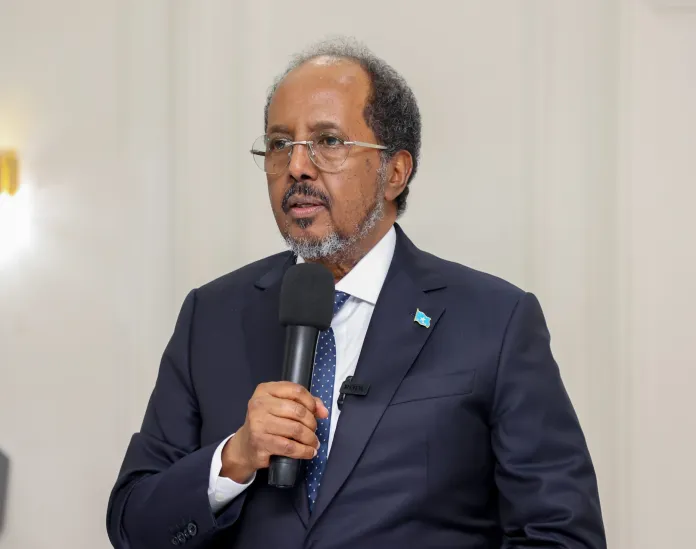

Somalia’s political debate has increasingly focused on President Hassan Sheikh Mohamud’s changing positions, particularly the contrast between his arguments as an opposition leader and the decisions he has defended since returning to office.
The central question is whether Hassan Sheikh remains committed to the principles and promises he made while challenging the previous administration, or whether the responsibilities and interests of holding presidential power have altered his political position.
Understanding the debate requires examining his earlier statements, his opposition to former President Mohamed Abdullahi Farmaajo, the constitutional changes introduced under his administration and the way opposition figures assess his leadership today.
After leaving office in 2017, Hassan Sheikh became one of the leading critics of Farmaajo’s government. During the electoral crisis of 2021, he strongly opposed attempts to extend the president’s mandate beyond the constitutionally established term.
He argued that political leaders must respect their legally defined terms in office and that a president should not unilaterally prolong his tenure.
In an April 2021 report, The EastAfrican quoted Hassan Sheikh describing an attempt to impose an extension as equivalent to a military coup and warning that Farmaajo would bear responsibility for the consequences.
He also accused Farmaajo of failing to implement the September 17, 2020 electoral agreement and called for renewed negotiations to resolve the political deadlock.
His position at the time was clear: presidential mandates should be respected, and electoral disagreements should be settled through dialogue and political consensus rather than unilateral decisions.
However, the political situation changed after Hassan Sheikh returned to Villa Somalia.
He was elected president on May 15, 2022, promising to prioritise the fight against Al-Shabaab, strengthen state institutions, complete the constitutional review process and introduce a direct, one-person, one-vote electoral system.
His administration argued that Somalia could no longer rely indefinitely on the indirect electoral arrangements that had shaped the country’s political system for years. It maintained that citizens should eventually have the opportunity to elect their leaders directly.
But disagreements emerged over how the proposed reforms should be implemented, the extent of federal authority, relations with regional administrations and which political institutions should determine the electoral framework.
Opposition politicians argued that major constitutional and electoral changes were being pursued without sufficient political agreement. The government, meanwhile, defended the reforms as necessary for building stronger institutions and moving Somalia towards a more democratic system.
The most contentious issue has been the presidential mandate.
In 2021, Hassan Sheikh opposed Farmaajo’s attempt to remain in office beyond his scheduled term.
In 2026, as his own mandate approached its constitutional end, he supported constitutional amendments that extended presidential and parliamentary terms to five years. His administration argued that the changes, approved by parliament, entitled the current leadership to remain in office until May 2027.
Opposition figures have described this as a double standard, arguing that Hassan Sheikh is now defending an extension similar to the one he previously condemned under Farmaajo.
The government rejects that comparison. It maintains that the extension is based on constitutional amendments passed by parliament and is therefore legally different from the disputed move attempted by the previous administration.
The disagreement, however, goes beyond whether Somalia should adopt direct or indirect elections.
It concerns whether the new electoral arrangements were agreed upon by the country’s political stakeholders and whether constitutional amendments can legitimately be applied to extend the mandates of leaders already in office.
The dispute reached a critical point on November 7, 2026, when Somalia’s Supreme Court issued a ruling on the presidential mandate and the application of the constitutional amendments.
According to an Associated Press report published that day, the court ruled that Hassan Sheikh’s term had expired and rejected the retrospective application of the constitutional amendments to the current presidential mandate.
The court also gave political stakeholders 30 days to agree on an electoral framework and ordered that elections be held within 90 days. It further restricted the federal government to routine administrative responsibilities.
The ruling added another dimension to the political confrontation because it challenged the legal basis on which the government had defended its continued tenure.
The AP report also said the court rejected the removal of Chief Justice Baashe Yusuf Ahmed, a decision that further intensified tensions between the presidency and the judiciary.
The ruling raises an important constitutional question: if the government maintains that the amended Constitution authorises it to remain in office until 2027, how should the dispute be resolved when the country’s highest court reaches a different interpretation?
So, who is telling the truth: Hassan Sheikh or the opposition?
The question should be assessed by comparing the available statements, political decisions and legal arguments rather than simply branding one side dishonest.
Hassan Sheikh’s position in 2021 was that a president should not extend his mandate without a legitimate constitutional and political basis.
His current position is that parliament’s approval of constitutional amendments provides the legal authority for the extension. The difference between those positions is clear and requires a convincing explanation to the Somali public.
The opposition argues that the presidential mandate has ended and that a new electoral arrangement must be agreed upon through political negotiations.
Its position is based on the previous constitutional framework, earlier political agreements and the principle that incumbent leaders should not determine the length of their own tenure.
However, opposition groups also face an obligation to present a practical and credible electoral proposal capable of moving the country beyond the current deadlock.
The government, for its part, argues that direct elections are necessary to end Somalia’s dependence on indirect voting arrangements. But introducing a new electoral system requires more than parliamentary approval.
It also depends on adequate preparations, functioning institutions and broad political confidence in the process.
International partners have also expressed concern about the implications of Somalia’s political divisions.
In May 2026, the Institute for Security Studies (ISS Africa) warned that failure to reach a political agreement could deepen instability surrounding the constitutional and electoral disputes.
Puntland and Jubbaland have rejected aspects of the federal government’s constitutional and electoral approach, demonstrating that the disagreement extends beyond the opposition and Villa Somalia.
It has become a broader dispute involving federal and regional authorities over the country’s political future.
International partners are therefore expected to support negotiations aimed at producing an electoral framework accepted by the main political stakeholders.
Their engagement is particularly important in preventing political disagreements from escalating into security confrontations at a time when Somalia is still fighting Al-Shabaab.
Ultimately, the contrast between Hassan Sheikh’s opposition-era statements and his current defence of the constitutional amendments raises a wider question about political consistency in Somalia.
While in opposition, he argued that presidential mandates must be respected and that unilateral extensions were unacceptable. As president, he has defended a constitutional process that his administration says allows him to remain in office until 2027.
That shift deserves serious public scrutiny. The issue is not simply what Hassan Sheikh said yesterday and what he is saying today, but whether Somali politicians are prepared to uphold the same principles when they move from opposition into government.
Leadership requires more than defending principles when they serve one’s political interests. Equally, opposition politics should involve more than rejecting government decisions without offering workable alternatives.
For Somalia to overcome its recurring electoral crises, political leaders must demonstrate consistency, respect constitutional institutions and negotiate in the national interest, regardless of who holds power.