

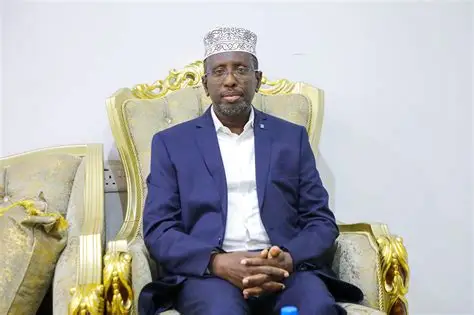

Former Somali President Sheikh Sharif Sheikh Ahmed has criticized the foreign policy of President Hassan Sheikh Mohamud, arguing that Somalia should pursue a clear, independent policy based on national interests rather than becoming entangled in rivalries between regional powers.
Sharif questioned the president’s recent diplomatic engagements with Ethiopia and Egypt, saying it was problematic for Hassan Sheikh to visit Addis Ababa and Cairo within a short period despite the two countries’ competing interests over regional security, the Nile and Red Sea access.
“It is a disgrace for Somali diplomacy that Hassan Sheikh lands in Addis Ababa and travels to Cairo the following day,” Sharif said. His remarks were reported on October 8 amid heightened regional tensions.
Sharif called for Somalia’s foreign relations to be guided by mutual interests, good-neighborliness and respect, warning against becoming directly involved in disputes between other countries.
The comments come at a particularly sensitive moment in the Horn of Africa.
Ethiopia and Egypt remain divided over the Grand Ethiopian Renaissance Dam and other regional issues, while tensions involving Ethiopia, Eritrea and Egypt have recently intensified.
The African Union has urged the countries to exercise restraint and resolve disputes through diplomacy.
Somalia maintains important relations with both Ethiopia and Egypt.
Hassan Sheikh visited Addis Ababa in late September and subsequently travelled to Egypt, where he met President Abdel Fattah el-Sisi and participated in a quadrilateral summit with Egypt, Eritrea and Sudan on October 4.
The summit’s joint declaration emphasized sovereignty, territorial integrity, regional cooperation and peaceful resolution of disputes.
Somalia’s relationship with Ethiopia has also been complicated by the 2024 Ethiopia-Somaliland memorandum of understanding, which Mogadishu viewed as a threat to Somalia’s sovereignty and territorial integrity.
At the same time, Hassan Sheikh has recently indicated that Somalia is prepared to negotiate commercial access to its ports for landlocked Ethiopia, provided any arrangement remains under Somali sovereignty.
Sharif argued that Somalia should maintain constructive relations with different countries without allowing itself to become part of their geopolitical confrontations.
“We do not want to become involved or entangled in the problems between governments and groups,” he said, emphasizing that Somalia’s foreign policy should ultimately serve Somali interests.
His criticism reflects a broader debate over how Mogadishu should navigate increasingly complex rivalries in the Horn of Africa and Red Sea region.
With Ethiopia again demanding access to the Red Sea and regional tensions rising, Somalia faces competing strategic pressures from neighboring and international powers.
Sharif also linked foreign policy to Somalia’s internal political crisis, arguing that major national issues should be resolved through dialogue among Somalis rather than through external intervention.
He called for political negotiations over elections and the peaceful transfer of power, while accusing the government of pursuing policies that could deepen political divisions.
Those accusations are political claims by the former president and should be distinguished from independently established facts.
Sharif’s remarks highlight the close connection between Somalia’s domestic and foreign policies.
As political divisions over elections and governance continue, disagreements over relations with Ethiopia, Egypt and other regional powers are also becoming part of the wider contest over Somalia’s political direction.