

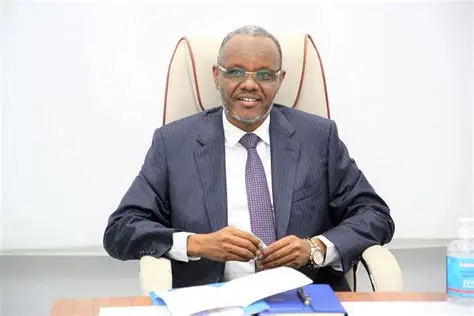

Former South West State President Abdiaziz Hassan Mohamed Laftagareen has issued a strong warning over Türkiye’s growing role in Somalia, cautioning Ankara against becoming directly or indirectly involved in the country’s political and clan disputes.
Laftagareen said it would be extremely dangerous if Türkiye were to support a particular Somali clan in pursuit of its own interests or attempt to influence who governs Somalia or controls its resources. He stressed that foreign involvement along clan lines could deepen existing divisions in a country where clan-based political competition remains a major challenge.
The latest concerns are closely linked to the political confrontation in South West State, particularly in Baidoa.
Tensions between President Hassan Sheikh Mohamud’s federal government and Laftagareen escalated in recent months, eventually developing into an armed confrontation after federal forces moved into Baidoa while Laftagareen and forces loyal to him sought to regain influence in the city.
The dispute subsequently moved beyond a political disagreement, with Baidoa and surrounding areas becoming a flashpoint between rival Somali forces.
Laftagareen and his supporters have accused Türkiye of backing the federal government, particularly during the fighting around Baidoa.
In September 2026, allegations emerged from Laftagareen’s side that Türkiye had used military aircraft and other military equipment during the Baidoa conflict.
The allegations have not been independently verified, and Türkiye has not officially acknowledged direct involvement in the fighting.
Laftagareen has also previously made allegations concerning an airstrike in Doolow, claiming that information available to him indicated the involvement of Turkish nationals. That allegation, too, has not been independently verified.
Ankara has previously rejected accusations that it is interfering in Somalia’s domestic politics. In May 2026, Türkiye’s Directorate of Communications’ Centre for Combating Disinformation dismissed claims that Ankara was supporting particular Somali politicians as unfounded.
Türkiye maintains that its presence in Somalia is based on a formal partnership with the Federal Government of Somalia, focusing on training and strengthening the Somali security forces, rebuilding state institutions and supporting efforts against Al-Shabaab.
Ankara has also stated that its military personnel are not involved in Somalia’s elections or domestic political disputes.
Türkiye’s interests in Somalia, however, extend beyond security. Its economic engagement has expanded into areas including energy, fisheries, infrastructure and hydrocarbons.
In 2024, the two countries signed agreements covering defence and economic cooperation, while Türkiye also committed to supporting Somalia in protecting its territorial waters and developing its naval capabilities.
Türkiye has also moved into Somalia’s energy sector. Reuters reported in January 2026 that the Turkish drilling vessel Cagri Bey was scheduled to operate in Somali waters as part of the two countries’ energy agreements.
The Somali government views such cooperation as a potential source of long-term economic development and a way to reduce dependence on foreign assistance, while critics question the extent to which Türkiye could gain political and economic influence in the country.
Türkiye’s growing role has made it an increasingly visible actor in Somalia’s political landscape.
Ankara’s close relationship with the federal government means that its actions can become politically sensitive whenever disputes emerge between the federal authorities and opposition figures or regional administrations.
However, there is currently no independent evidence establishing that Türkiye has officially adopted a policy of supporting a particular Somali clan.
Türkiye continues to maintain that its partnership is with the Federal Government of Somalia and is aimed at security, stability, institution-building and broader bilateral cooperation.
The allegations surrounding military involvement also require careful distinction between political influence and potential violations of international law.
Supporting a political side or maintaining close relations with a government does not, by itself, constitute a war crime.
War crimes have specific legal definitions, and establishing such crimes requires evidence concerning the conduct, intent, targets and circumstances of a particular incident.
This is particularly important regarding allegations of airstrikes in Baidoa and Doolow.
Where claims involve civilian deaths or indiscriminate attacks, an independent investigation would be necessary to establish who carried out the attack, who ordered it, what the intended target was and whether the operation complied with international humanitarian law.
Türkiye’s modern engagement with Somalia dates back to President Recep Tayyip Erdoğan’s landmark visit to Mogadishu in 2011, when Somalia was facing a severe drought and humanitarian crisis.
Since then, Ankara has expanded its involvement in humanitarian assistance, education, healthcare, infrastructure and security. Türkiye also reopened its embassy in Mogadishu in 2011, after it had been closed since 1991.
Laftagareen’s warning therefore comes at a time when Türkiye has become one of Somalia’s most important foreign partners.
While Ankara says its involvement is intended to strengthen Somalia’s state institutions and security sector, the growing depth of the relationship means that any perception of political or military favoritism could have significant consequences for Somalia’s already fragile political balance.