


Somaliland has stated that it is pursuing efforts to fully take over the management of its airspace, while also working to eliminate Somalia’s electronic visa system, the E-Visa, which Somaliland claims is being forced upon travelers heading to Hargeisa.
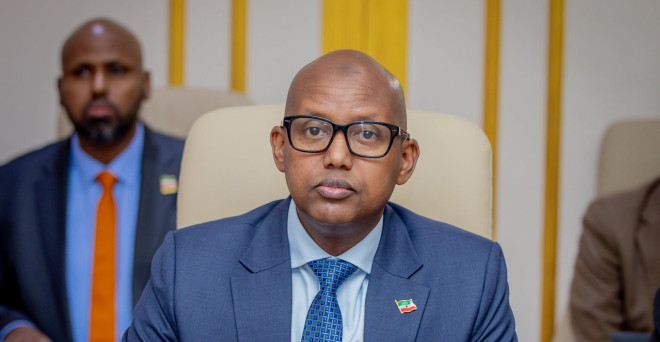
Somaliland’s Minister of the Presidency, Khadar Hussein Abdi, speaking to members of the Somaliland diaspora in the United States, stated that the government is undertaking carefully managed diplomatic and other efforts.
The minister stated that Somaliland’s Minister of Aviation and Airports Development, Fu’ad Ahmed Nur, is specifically engaged in matters related to flights and challenges concerning airspace management.
“Minister Fu’ad is handling aviation matters and the challenges existing in the airspace with wisdom and discretion, and we hope he will achieve success soon,” said Khadar Hussein.
He added that Somaliland’s Minister of Aviation is still in the United States, where he is continuing tasks related to aviation matters and airspace management.
The issue of airspace management has long been one of the sensitive points in the political dispute between Somaliland and the federal government of Somalia.
Somaliland argues that since it controls its airports and territory, it should solely manage aviation and airspace matters related to those airports.
The Somaliland government has also stated on several occasions that travelers to Hargeisa and other airports in Somaliland cannot be forced to obtain the E-Visa issued by the federal government of Somalia.
On the other hand, Somalia operates an electronic visa system intended for foreign nationals entering the country, with the federal government viewing the E-Visa/ETAS as the official mechanism for travel.
This dispute specifically impacts passengers and airlines, as individuals traveling to Hargeisa may face conflicting requirements regarding visas and travel authorization.
Minister Khadar also mentioned in his remarks the recognition granted to Somaliland by Israel, stating that some of the Somaliland government’s diplomatic steps occur without prior public announcement.
“As you know, everyone simply woke up one morning to the recognition by Israel,” said Somaliland’s Minister of the Presidency.
He stated that President Abdirahman Mohamed Abdullahi Irro manages foreign policy in what he described as a “quiet and discreet” manner, noting that the airspace management issue is part of those efforts.
The issue of Israeli recognition has also become a critical point affecting relations between Somaliland and Somalia.
Somaliland views this recognition as an important diplomatic milestone in its pursuit of international recognition, whereas the Somali government has strongly opposed the move.
Airspace management, meanwhile, holds unique significance, as international flights rely on systems and agreements related to aviation safety, aircraft authorization, and airspace control.
Somaliland wants airlines and flights operating to its airports to deal directly with aviation authorities in Hargeisa.
Conversely, the federal government of Somalia insists on its authority regarding national affairs and the management of Somalia’s airspace.
Therefore, the E-Visa and airspace management dispute is not merely a matter concerning passengers and airlines, but forms part of the broader political conflict between Somaliland and the federal government of Somalia.
Somaliland’s Minister of the Presidency stated that ongoing efforts to resolve these matters are continuing, with the Minister of Aviation and Airports Development of Somaliland pressing ahead with meetings and tasks related to aviation issues from the United States.
To date, the formal results of those efforts and Somaliland’s next steps regarding Somalia’s E-Visa system have not been officially announced.
The issue is expected to remain a prominent feature in relations between Hargeisa and Mogadishu, particularly as Somaliland pursues measures to strengthen its foreign relations and the jurisdiction it claims over its territory, airspace, and airports.