

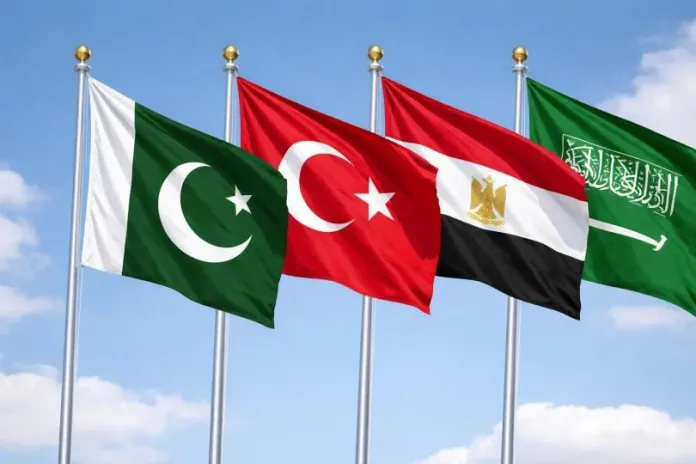

The first meeting of the newly established Strategic Policy and Defense Committee of Turkey, Saudi Arabia, and Pakistan is set to take place in Istanbul on Monday, marking a significant step in implementing a trilateral defense agreement signed by the three countries in Mecca on August 7, 2026.
The meeting will bring together the foreign and defense ministers, senior military officials, and security representatives from the three nations. The aim is to establish a formal framework for cooperation on security, defense policy, military coordination, and strategic planning.
The agreement signed in Mecca has drawn international attention because it includes a collective defense provision stating that an armed attack against one member state would be considered an attack against all three.
Pakistani officials have emphasized that the pact is purely defensive in nature and is not directed against any specific country.
Monday’s gathering in Istanbul represents the first formal effort to translate the agreement into practical mechanisms and institutional structures.
Discussions are expected to focus on global and regional security challenges, military cooperation, counterterrorism efforts, defense modernization, intelligence coordination, and the expansion of defense industry partnerships.
The three countries bring different strengths to the partnership. Turkey possesses one of the most advanced defense industries in the Muslim world, producing drones, naval platforms, armored vehicles, and other military equipment.
Pakistan maintains one of the region’s largest armed forces and is the only Muslim-majority country with nuclear weapons.
Saudi Arabia contributes significant financial resources and has been investing heavily in defense and security capabilities as part of its broader strategic transformation.
Together, these capabilities give the new partnership considerable geopolitical weight, although analysts caution against describing it as a “Muslim NATO.”
Experts note that the alliance remains in its early stages, and its future structure, obligations, and operational capacity have yet to be fully defined.
Potential Implications for Somalia
Somalia has particularly close ties with all three countries involved in the agreement, especially in the fields of diplomacy, security, and development cooperation.
Turkey has emerged as one of Somalia’s closest strategic partners over the past decade.
The two countries signed a major defense cooperation agreement in 2024 that expanded Turkey’s role in training, equipping, and supporting Somalia’s security forces, including the development of the Somali Navy and efforts to strengthen maritime security.
As cooperation among Turkey, Saudi Arabia, and Pakistan deepens, Somalia could indirectly benefit from opportunities arising from the partnership, particularly in military training, maritime security, counterterrorism operations, and defense capacity-building.
Somalia’s strategic location further enhances its relevance to regional security calculations.
The country possesses Africa’s longest coastline, stretching along key maritime routes linking the Indian Ocean, the Gulf of Aden, and the approaches to the Red Sea—waterways that are vital to global trade and energy shipments.
Both Turkey and Saudi Arabia have strong interests in the security of the Red Sea region, while Pakistan maintains significant military, economic, and strategic ties with Gulf states.
If the trilateral partnership expands its focus on maritime cooperation, Somalia could become an increasingly important partner due to its proximity to some of the world’s busiest shipping lanes.
Such cooperation could also support efforts to combat piracy, human trafficking, arms smuggling, and illegal fishing in Somali waters and across the wider western Indian Ocean region.
Could the Alliance Expand?
There has been growing speculation that additional countries may eventually join or cooperate with the new framework. Pakistani officials have indicated that the agreement could be open to other states that share its principles and strategic objectives.
Bangladesh has already been mentioned in regional discussions as a country considering closer engagement with the initiative.
Any future participation by Dhaka would increase the alliance’s strategic significance, particularly given Bangladesh’s growing economic and military profile and its regional relationships in South Asia.
For Somalia, any future participation in the framework would require careful political and diplomatic consideration.
While Mogadishu maintains strong relations with Turkey, Saudi Arabia, and Pakistan, it also relies heavily on partnerships with the United States, the European Union, the African Union, and other international allies that support Somalia’s security, development, and state-building efforts.
Analysts say Somalia would need to carefully balance its regional and global partnerships if the new defense bloc evolves into a broader strategic alliance.
For now, however, the Istanbul meeting is being closely watched as a potential milestone in the emergence of a new security partnership linking three of the Muslim world’s most influential military and political powers.