

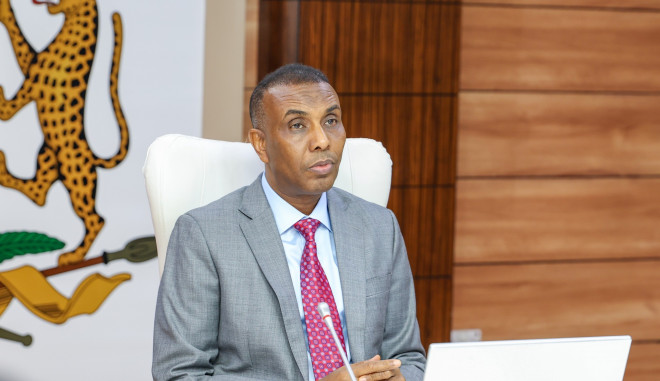

Somali PM Hamza Abdi Barre has urged UN agencies, donors and international organizations to change how they operate in Somalia, saying the country should no longer be treated as a transitional state lacking functioning institutions.
Barre said Somalia has made significant progress in rebuilding its state institutions and developing a functioning legal and constitutional framework, and argued that international partners should adjust their policies and operations to reflect those changes.
The prime minister criticized what he described as outdated working practices in which some international organizations continue to manage important aspects of their Somalia operations from outside the country, particularly from neighboring Kenya.
“There are people working for us who still want to manage Somalia from Nairobi. That is the way they have become accustomed to working, but that is no longer possible. We want them to adapt to the new Somalia and where we are heading,” Barre said.
Government seeks to move beyond the transitional model
Barre linked his criticism to the Federal Government’s broader state-building agenda, particularly the National Transformation Plan (NTP), which the government has presented as a framework for moving Somalia away from the prolonged transitional and externally managed systems that characterized much of the country’s post-conflict recovery.
For years, Somalia’s international engagement has involved extensive reliance on UN agencies, humanitarian organizations, foreign donors and international implementing partners.
Many programs have also been coordinated from regional hubs outside Somalia, particularly Nairobi, because of security concerns and the limited capacity of Somali institutions.
The prime minister’s comments indicate that the government now wants international assistance to increasingly operate through Somali institutions and within Somalia rather than maintaining structures designed for an earlier stage of the country’s recovery.
Barre argued that the country’s development priorities should be increasingly determined and implemented through national institutions as Somalia seeks to strengthen its sovereignty, administrative capacity and ability to deliver public services.
A call for international partners to adapt
The prime minister urged UN agencies, donors and international organizations to recognize the changes taking place within Somalia and abandon approaches that were developed during periods when state institutions were significantly weaker.
He said international partners should not continue operating under the assumption that Somalia lacks the institutions, laws and systems necessary to manage national programs.
The call is particularly relevant to development and humanitarian operations, where international organizations continue to play a major role in providing assistance, financing projects and supporting government institutions.
Barre’s position appears to be that such assistance should increasingly strengthen Somalia’s own institutions rather than create parallel systems that remain dependent on international organizations.
Government officials also face pressure to change
The prime minister acknowledged that the transformation cannot be expected from international partners alone.
He said Somalia’s own ministers, government officials and technical experts must also adapt to the new system and take greater responsibility for managing national programs and institutions.
According to Barre, the change must begin within the government itself, with public officials expected to develop the skills and capacity required to operate modern state institutions and engage international partners on a more equal footing.
This approach reflects a broader argument within Somalia that state-building should eventually move from externally supported administration toward stronger national ownership.
Why Nairobi remains central to international operations
Nairobi has for decades served as a major regional base for international organizations working on Somalia.
During the years of conflict and weak central government, security concerns and limited infrastructure made it difficult for many international agencies to operate fully from Mogadishu and other parts of the country.
As Somalia’s security and government institutions have developed, however, successive administrations have pushed for greater international presence and decision-making inside the country.
Barre’s remarks therefore revive a longstanding debate over the extent to which international organizations should maintain regional offices outside Somalia while implementing programs inside the country.
The prime minister’s argument is that continuing to manage major operations from abroad risks reinforcing a model of international engagement that belongs to Somalia’s transitional period rather than its current state-building phase.
The wider significance
The government’s position also reflects Somalia’s broader effort to strengthen national ownership of development, security and institutional reforms.
Somalia continues to rely heavily on international financial and technical assistance, particularly in areas such as humanitarian relief, infrastructure, governance and security.
At the same time, the government wants to reduce long-term dependence on externally managed systems and increase the capacity of Somali institutions to plan, implement and monitor national programs.
The challenge will be finding a balance between greater Somali ownership and the continued need for international expertise, financing and technical support.
For international partners, the prime minister’s message is that cooperation with Somalia should increasingly be based on partnership with national institutions rather than arrangements designed around the country’s former transitional status.
Barre’s remarks ultimately underline the government’s ambition to present Somalia as a state moving toward greater institutional maturity and self-reliance.
But achieving that objective will require not only changes in how international organizations operate, but also continued improvements in the capacity, transparency and accountability of Somalia’s own public institutions.