

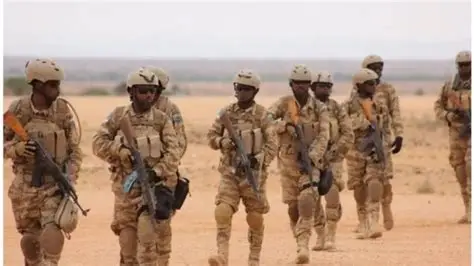

The Puntland administration has formally declared that the Puntland Security Force (PSF) is not a legally recognized security institution, escalating a long-running dispute that has repeatedly erupted into deadly clashes and underscoring growing tensions between Garowe and Mogadishu over control of security forces.
The declaration came in a statement from the Puntland Presidency following recent fighting near the village of Laag, outside Bosaso, where Puntland Darawiish forces clashed with fighters affiliated with the PSF.
Puntland authorities said eight PSF personnel were captured during the confrontation, along with several military vehicles.
“The Puntland Government confirms that there is no force legally recognized within Puntland’s defense institutions known as the PSF,” the statement said.
The regional administration also rejected the presence of any federally registered military units operating within Puntland without its authorization.
Origins of the PSF
The Puntland Security Force was established in 2004 as a specialized counterterrorism unit with international support and initially operated under Puntland’s security structure.
Over the years, however, disputes over its command structure and operational independence have repeatedly placed the force at odds with Puntland authorities.
Unlike other regional security units, the PSF has historically maintained an independent chain of command, fueling recurring political and military tensions.
Dispute Dates Back to 2021
The current conflict traces its roots to November 2021, when Puntland President Said Abdullahi Deni attempted to dismiss then-PSF commander Mohamud Osman Diyano.
The move sparked intense fighting in Bosaso that left nearly 20 people dead before traditional elders mediated the crisis. President Deni later reinstated Diyano in March 2022 following negotiations.
A new chapter in the dispute emerged in October 2024, when Somalia’s Federal Government announced that the PSF had been fully integrated into the Somali National Armed Forces, placing the unit under federal command while assuming responsibility for its salaries, equipment, and leadership.
Laag Clashes Intensify the Crisis
The latest violence erupted on July 20 near Laag, where Puntland Darawiish forces confronted PSF units traveling from Bosaso.
What initially appeared to be a standoff quickly escalated into heavy fighting before Puntland security forces, reinforced by additional troops, surrounded the PSF fighters.
According to Puntland officials, the outnumbered PSF members later withdrew through the surrounding mountains overnight, leaving behind several armed vehicles used during the confrontation.
Conflicting Narratives
The PSF has maintained that its forces were conducting a routine security operation and denied posing any threat to Puntland’s stability.
A PSF spokesperson told local media that the unit has served as one of Somalia’s leading counterterrorism forces for many years and remains committed to combating extremist groups.
Puntland, however, described the operation as a planned security mission targeting armed groups it considers a threat to regional stability.
Political Dispute Behind the Military Confrontation
The PSF dispute reflects a broader political confrontation between Puntland and Somalia’s Federal Government.
Puntland has repeatedly accused President Hassan Sheikh Mohamud’s administration of supporting military activities intended to weaken the regional administration and fuel instability inside Puntland.
The Federal Government has not publicly responded to those accusations.
Relations between the two sides have deteriorated over several issues, including constitutional amendments rejected by Puntland, disagreements over federal authority, and competing claims regarding command of security forces operating inside the region.
Puntland has also prohibited federal security forces from operating in major towns under its control without authorization, barred federal recruitment activities within the region, and restricted visits by some federal officials.
The Diyano Family’s Continued Influence
The Diyano family remains central to the dispute.
The PSF has been closely associated with the Diyano family since its creation. Somalia’s current Police Commissioner, General Asad Osman Abdullahi Diyano, previously commanded the PSF, while members of his family continue to maintain close ties to the force.
Puntland’s latest declaration effectively labels forces associated with the Diyano network as operating outside the region’s legal security framework.
However, the Federal Government’s recognition and continued support of the PSF mean the unit remains active despite Puntland’s position.
Recent security incidents in Garowe, including an exchange of gunfire involving individuals allegedly linked to the PSF that reportedly left two soldiers dead, have further highlighted the continuing tensions.
A Constitutional Grey Area
The dispute also exposes broader weaknesses within Somalia’s federal system.
Somalia’s Provisional Constitution does not clearly define the division of security responsibilities between the Federal Government and federal member states.
Puntland argues that regional governments have exclusive authority over police and internal security, while the Federal Government is responsible only for national defense.
The PSF occupies a legally contested position between those two mandates—a federally backed counterterrorism force operating inside a federal member state that rejects its legal status.
A Dispute With No Immediate Resolution
Puntland’s declaration that the PSF has no legal standing represents one of its strongest official positions on the issue to date.
However, the statement does little to resolve the underlying political and constitutional dispute. Instead, it reinforces a division that has already resulted in repeated armed confrontations and loss of life.
The Federal Government’s continued silence on Puntland’s latest declaration has been interpreted by observers as an effort to avoid escalating the confrontation publicly while maintaining its support for the PSF.
For international partners that have invested heavily in Puntland’s security institutions and Somalia’s federal system, the dispute presents a difficult dilemma.
Supporting Puntland risks straining relations with Mogadishu, while backing the Federal Government strengthens a force that Puntland considers illegal.
Without a negotiated political settlement, analysts warn that the dispute over the PSF is likely to remain one of the most significant security and constitutional flashpoints in Somalia.