

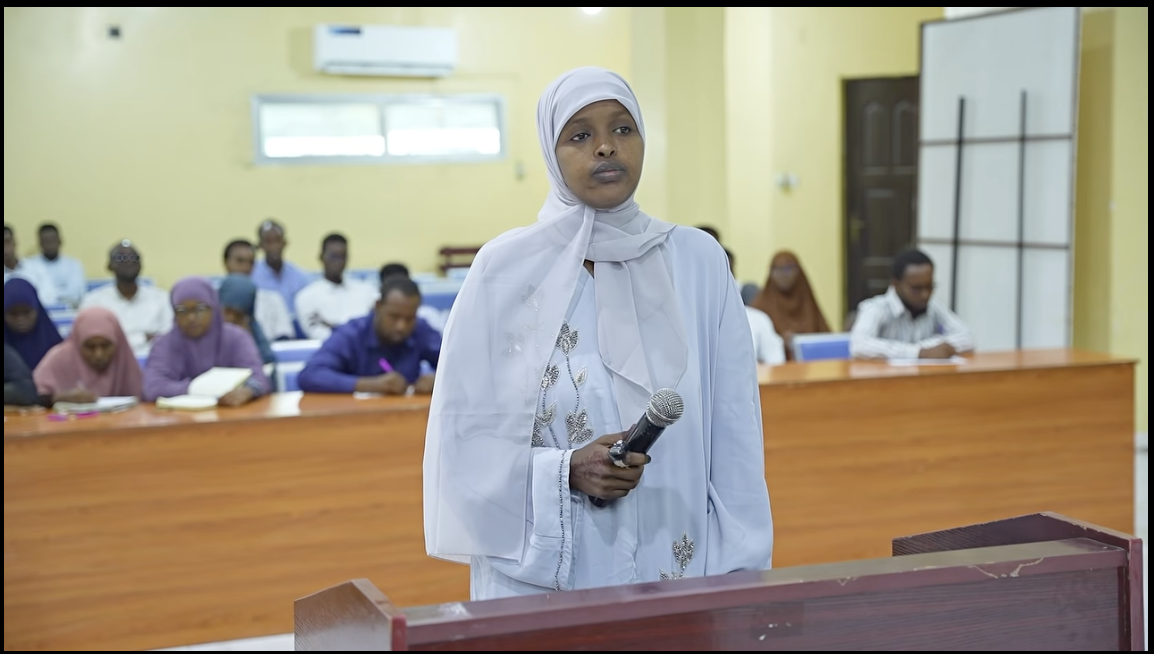

My name is Sadia Moalin Ali Hassan. I am a Somali mother with a 12-month-old child who still depends on breastfeeding, care, and a mother’s love. My child needs my presence, and I have a responsibility to fulfill my duties as a mother. My lawyers have argued that my role as a mother, my child’s dependence on me, and the fact that my child is still breastfeeding are circumstances that deserve careful consideration under the law and by the court.
In addition, I suffer from asthma, which has caused me significant hardship. As I have repeatedly stated, I have not received the medical care that my condition requires. I therefore request immediate access to an independent doctor to assess my health and ensure that I receive the medication, treatment, and living conditions necessary for my well-being.
I have been in detention since 12 April 2026, and on 14 April I was transferred to Mogadishu Central Prison. On 25 June 2026, the Banadir Regional Court sentenced me to three years’ imprisonment. I do not admit, and have never admitted, committing any crime. I believe I am being persecuted because of my peaceful statements and opinions that I have expressed, and that the judgment against me was not the product of an independent judicial process free from pressure or interference.
I believe that I have been deprived of my rights that were guaranteed to me under the Constitution. I feel that state power has been wrongly used against me and that I am being punished for expressing my views. Nevertheless, I do not want my case to become a tool for political confrontation, social conflict, or clan disputes. I do not want any individual or group to use my case to advance their own agenda in ways that could further complicate my situation. I ask only that my case be decided according to the law, credible evidence, and justice.
My Concerns About the Handling of My Case
My case was initially assigned to a judge whom I expected would hear it independently. I was later informed that the case file was taken over by the Chairman of the Banadir Regional Court, who also became the judge responsible for delivering the judgment against me. I believe this raises legitimate questions about the impartiality and independence that can reasonably be expected when a court president presides over a case brought by the very government that appointed him.
I Am Not Seeking a Presidential Pardon
I wish to make my position absolutely clear. I am not seeking a presidential pardon because I do not admit to committing any offence. A pardon is generally sought by someone who pleads guilty and asks to have a sentence forgiven or reduced. Instead, I seek a fair trial and a judgment based on the law and reliable evidence. I also seek an independent appeal that thoroughly reviews the way my case was handled, the evidence presented, the procedural safeguards afforded to me, and the legal reasoning behind my conviction.
I do not want emotional rhetoric or exaggerated statements that could damage my appeal.
I do not want my case to be reduced to clan politics or tribal divisions, which would only make my situation more difficult.
I do not want anyone to be abused or harmed because of my case.
Justice is a public trust and the foundation of every individual, family, society, and state. The judiciary must remain independent from political, social, economic, and clan-based pressure.
As Allah says in the Holy Qur’an:
Indeed, Allah commands you to return trusts to their rightful owners; and when you judge between people, judge with fairness. What a noble commandment from Allah to you! Surely Allah is All-Hearing, All-Seeing. (Quran: 4:58)
Judicial office is not merely an authority to pass judgment; it is a responsibility entrusted by both God and society. Judges must treat all people equally, regardless of power, wealth, clan identity, public office, or personal connections. Before delivering judgment, a judge should remember that the person standing before the court has a dignity, a family, children, a life, and constitutional rights deserving of protection.
What I Am Asking For
In summary, I respectfully request the following:
- A prompt and independent appeal. I ask that my appeal be heard without delay by an independent court that impartially reviews the judgment, the evidence, and the procedures followed during my trial.
- An impartial judge. I seek a judge whose decisions are not influenced by the wishes or interests of other officials, and who does not fear losing their position for upholding the law and justice.
- A clear separation between court administration and judge making the decision. I request that my appeal be assigned to a judge who does not simultaneously hold senior administrative responsibilities that could create actual or perceived pressure. Justice must not only be done; it must also be seen to be done.
- Full access to my case file for my lawyers. My legal team should be provided with the complete written judgment, all prosecution evidence, and the records and transcripts of the court proceedings.
- Immediate medical care. I request an examination by an independent doctor and access to the treatment, medication, and healthcare my condition requires.
- Consideration of my child’s best interests. The court should carefully consider my infant child’s need for breastfeeding, maternal care, and the impact my absence may have on my child’s health and development. My child is not a party to this case and should not suffer an indirect punishment for circumstances beyond their control.
- A transparent public appeal hearing. I request that my appeal hearing be open to the public, where permitted by law, so that the proceedings can be observed and public rumors or conflicting reports can be minimized.
- A judiciary free from social media pressure. I ask for judges who decide cases based on the law and evidence, free from the influence of Facebook, TikTok, or other social media platforms. Judicial decisions should never be driven by popularity, public approval, or the desire to satisfy those in positions of power, but solely by justice and the rule of law.
- No retaliation in my name. I ask my supporters not to insult others or blame entire families or clans because of my case. I reject responding to injustice with further injustice. My conscience tells me that a victim cannot seek justice by victimizing innocent people.
Freedom of Expression and the Responsibility of the State
Citizens have the right to criticize their government, question its policies, and speak about unemployment, discrimination, corruption, poverty, and unequal opportunities. Freedom of expression does not place anyone above the law. Equally, the law must never become a weapon to silence criticism or intimidate those with less power.
Where a person is accused of unlawful speech, the authorities should clearly identify the specific statements alleged to be unlawful, explain which law they are said to have violated, and demonstrate the harm they caused. The accused must also be given a genuine opportunity to defend themselves.
The reality remains that the state possesses far greater power than an individual who is imprisoned. That is why the greatest responsibility rests with the government and the judiciary, both of which must demonstrate restraint, impartiality, and unwavering respect for the rule of law.
My Message to the Somali People
I ask the Somali public not to turn my case into a source of conflict, clan rivalry, insults, or revenge.
I encourage lawyers, religious scholars, women, mothers, journalists, academics, and human rights organizations to support every person’s right to a fair trial.
I am not asking for support because I belong to a particular clan.
Nor am I asking for support simply because I am a woman.
I ask for support because I am a Somali citizen entitled to justice, healthcare, and an independent judiciary.
Any one of us may one day stand before a court. If an unfair trial is accepted today, another person may face the same injustice tomorrow, until injustice becomes normalized.
Protecting my rights is therefore not only about protecting Sadiyo. It is about protecting the rights of every Somali citizen and safeguarding justice for both present and future generations.
Conclusion
No one should be oppressed through power, imprisonment, violence, intimidation, censorship, or the misuse of the law.
Somalia’s history contains many examples of people imprisoned because of their ideas, their speech, or their political views. My intention is not to compare myself with those who were unjustly treated in the past. Rather, I wish to remind my fellow Somalis that freedom of expression and an independent judiciary are precious values that every generation has a duty to preserve for the next.
By: Sadia Moalin Ali Hassan
Held at the Mogadishu Central Prison
___________
Note: This letter was sent by Sadia from Mogadishu Central Prison through her lawyer, Zakariye Ismail Nur, on 28 June 2026. The translation was done by Kaab TV team. Read the full letter in Somali