

MOGADISHU (Kaab TV) – The international community has expressed growing concern over Somalia’s current political situation and called on Somali leaders to urgently resume dialogue and reach an agreement on the country’s electoral process.
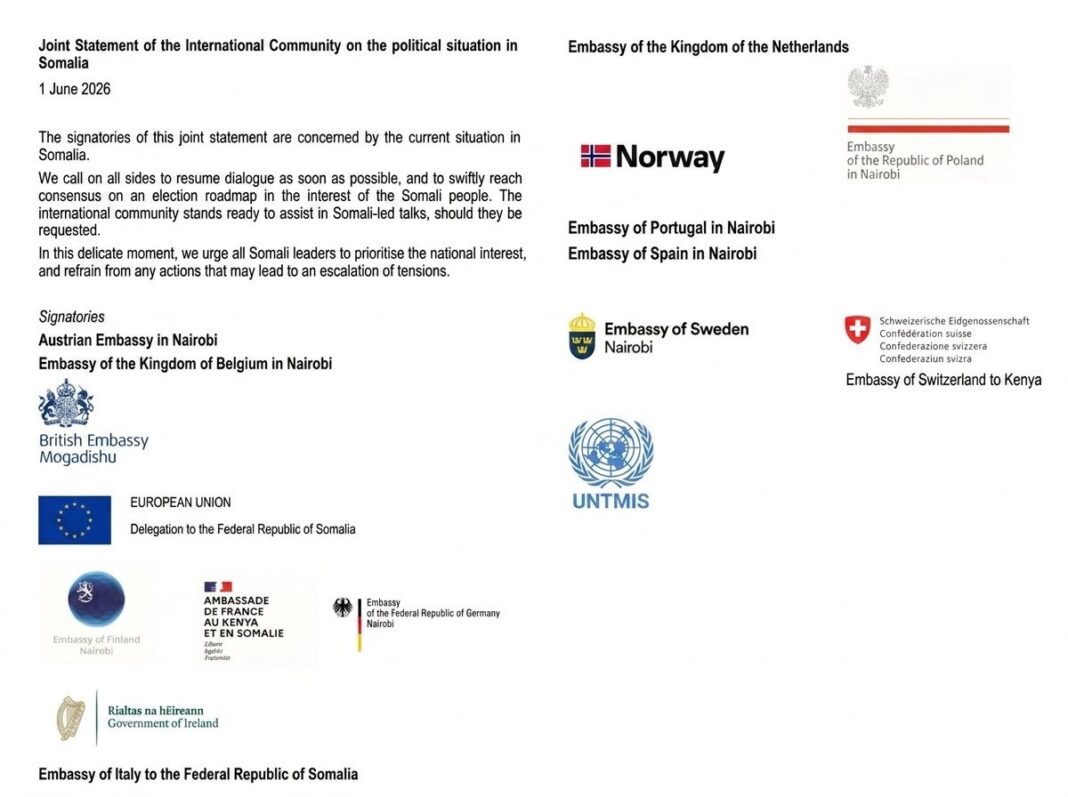
In a joint statement issued on June 1, 2026, international partners said they were deeply concerned about the ongoing political uncertainty and tensions surrounding Somalia’s election process.
“We call on all parties to resume dialogue as soon as possible and quickly reach consensus on the electoral framework in the interest of the Somali people,” the statement said.
The international partners also reaffirmed their readiness to support Somali-led discussions if requested by the parties involved.
“At this sensitive moment, we urge all Somali leaders to prioritize the national interest and avoid any actions that could further escalate tensions,” the statement added.
The statement was signed by the embassies of Austria, Belgium, Finland, France, Germany, Ireland, Italy, Netherlands, Norway, Poland, Portugal, Spain, Sweden, and Switzerland, as well as the British Embassy Mogadishu, the European Union Delegation to Somalia, and the United Nations Transitional Mission in Somalia.
The statement comes amid increasing political disagreements between the Federal Government of Somalia, opposition groups, and some federal member states over the structure and timing of upcoming elections.
Somalia’s electoral process has remained at a standstill due to deep disagreements over the type of elections to be held, the composition and powers of electoral management bodies, constitutional reforms, voter registration mechanisms, and the level of participation by opposition groups and regional administrations.
Opposition leaders have accused the federal government of attempting to dominate the electoral process after Hassan Sheikh Mohamud refused to step down as President and illegally extended his term to May 2027 without broad political consensus, while the government insists that it is pursuing democratic reforms aimed at transitioning Somalia toward a one-person, one-vote electoral system.
Some federal member states and opposition politicians have also raised concerns about security conditions, political inclusivity, and the lack of agreement on how national and regional elections should be organized.
Political tensions in Mogadishu have intensified in recent months following disputes over electoral procedures, opposition demands for wider consultation, and accusations of political interference and unilateral decision-making.
Somalia has experienced recurring political crises linked to elections, constitutional disputes, and power-sharing arrangements for more than a decade, often requiring mediation efforts by international partners and regional organizations.
Analysts warn that continued delays and political deadlock could undermine Somalia’s state-building efforts, weaken security cooperation, and distract from ongoing military operations against Al-Shabaab militants.
The international community has repeatedly emphasized that inclusive dialogue and political consensus remain essential for ensuring stability, democratic progress, and peaceful elections in Somalia.