

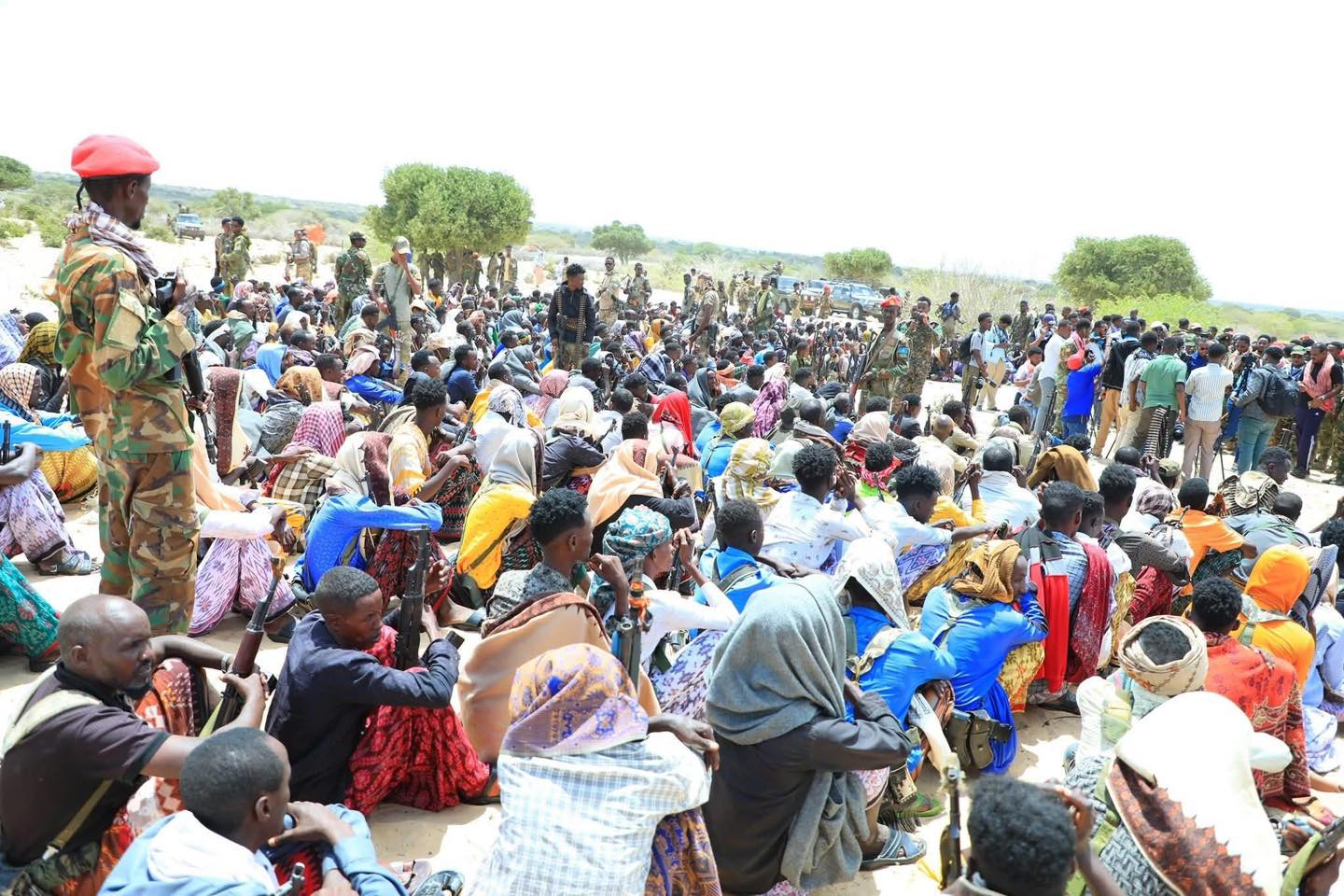

Mogadishu, Somalia —By 2026, the most revealing measure of Somalia’s counterterrorism crisis was no longer the number of airstrikes conducted or villages recaptured from the extremist group, al-Shabab. It was the widening gap between military advances and political control.
The federal government in Mogadishu could clear roads, retake towns and deploy soldiers into formerly militant-held districts. But across large parts of central and southern Somalia, it still struggled to convince local communities that state authority would endure after the security operations ended.
That contradiction increasingly sits at the center of Somalia’s war against insurgency.
For years, international strategy toward Somalia followed a familiar formula: strengthen the Somali National Army, expand intelligence coordination with foreign partners and gradually extend state authority into rural areas dominated by al-Shabab.
The model appeared to gain momentum during the 2022 and 2023 offensives, when clan militias known as Macawisley, backed by federal troops and international support, pushed militants from significant territory in central Somalia.
Somali officials described the campaign as a historic turning point, while Western diplomats cautiously spoke of renewed optimism.
But the advances concealed deeper structural weaknesses that became increasingly visible through 2024, 2025 and into 2026.
The Somali state expanded militarily faster than it reconciled politically.
Reciprocal Fragility and Layered Sovereignty
In many districts, neither the federal government nor the al-Qaeda affiliate group achieved decisive authority.
Instead, Somalia drifted into what some Somali analysts described as “reciprocal fragility”, a condition in which competing actors retain enough coercive power to block stabilization without fully controlling the political landscape.
The result was layered sovereignty.
Government officials administered district headquarters by day. Militants collected taxes at night. Clan elders mediated disputes outside both systems. Businesses paid multiple authorities simultaneously to ensure protection and commercial access.
Increasingly, international analysts warned that the insurgency was feeding less on military weakness than on political fragmentation.
Matt Bryden, a senior regional analyst and co-founder of the Sahan Research think tank, argued in late-2025 assessments that deteriorating relations between Mogadishu and Somalia’s federal member states were creating openings al-Shabab could exploit more effectively than direct battlefield confrontation.
Resistance to meaningful power-sharing, he warned, risked pushing Somalia toward a dangerous tipping point.
The broader concern emerging among researchers and diplomats was that Somalia’s conflict was becoming increasingly regionalized.
Federal authorities, regional administrations, Gulf-backed actors, clan networks and local militias were operating according to separate political and security calculations rather than a unified national strategy.
That fragmentation became especially visible in the government’s dependence on Macawisley militias.
The clan-based fighters became indispensable during the anti militants offensives because they possessed something the regular army often lacked: local legitimacy, clan trust networks and detailed territorial knowledge.
But by 2026, many of those same militias had become entangled in unresolved land disputes, revenge killings and inter-clan competition.
Analysts at the Rift Valley Institute described the Macawisley phenomenon as a “double-edged sword.” The militias emerged organically from local frustration with al-Shabab taxation, extortion and forced recruitment.
Yet the same clan structures that made them effective against militants also risked deepening local fragmentation once communities became rearmed.
In Somali political culture, disarmament is rarely viewed simply as a security issue. It is tied directly to communal survival.
Across much of rural Somalia, the state is often perceived not as a neutral institution but as an extension of whichever clan or sub-clan dominates local administration. The appointment of a district commissioner, deployment of a military commander or establishment of a checkpoint can quickly alter local power balances.
When one community feels excluded, al-Shabab has repeatedly shown an ability to exploit the resulting grievances.
The group’s resilience has long depended on more than ideology alone.
In many areas, it functions as an alternative governance structure capable of arbitrating disputes, regulating transport routes and enforcing commercial agreements across clan boundaries.
That reality increasingly led analysts to frame Somalia’s conflict less as a conventional counterterrorism campaign than as a competition over who could provide predictable order.
For traders moving goods through insecure territory, predictability often outweighs ideology.
That helps explain why many businesses in Mogadishu and the sprawling Bakara Market continue operating within a system of dual taxation, paying official state taxes while also transferring “security fees” to al-Shabab networks controlling rural corridors.
Among Somali transporters and traders, frustration over the arrangement has become increasingly visible in public debate. Yet the system also highlights a broader reality: many commercial actors do not necessarily support al-Shabab politically. They simply regard it as an unavoidable coercive authority.
This is not always ideological loyalty. Often, it is economic adaptation.
The same logic shapes local neutrality arrangements in rural districts, where communities sometimes negotiate informal understandings with militants to protect grazing access, water points or transport routes.
Certain counterterrorism frameworks frequently interpret such arrangements as collaboration with insurgents. Many Somali communities instead see them as pragmatic survival strategies in an environment where state protection remains inconsistent.
The gap between those interpretations has become one of the central weaknesses in international policy.
The transition from the African Union Transition Mission in Somalia to the newer African Union Support and Stabilization Mission in Somalia framework exposed those vulnerabilities further.
As African Union forces reduced their footprint during 2024 and 2025, Al-Shabab adapted strategically rather than confronting stronger military positions directly.
Regional analysts increasingly described the shift as a “wait-and-bleed” strategy.
Instead of focusing primarily on territorial battles, militants intensified assassinations, intimidation campaigns and targeted killings aimed at clan elders, mediators and local officials aligned with the federal government.
The objective was less about immediate territorial conquest than about weakening trust inside the political alliances supporting the counterinsurgency campaign.
The message delivered to communities was simple: governments may withdraw, but clans remain.
Versions of that sentiment spread widely across Somali social media during 2025 and 2026.
One phrase captured the skepticism especially clearly: “Dowladdu waa ku-meel-gaar, laakiin beeluhu waa weligood”, meaning that while the government is seen as temporary, the clan remains enduring and permanent.
The phrase reflected more than cynicism. It reflected political memory shaped by decades of state collapse and insecurity.
Since 1991, many Somali communities have relied on lineage networks, compensation systems and clan protection mechanisms more consistently than formal state institutions.
This is where counterterrorism operations often collide with older grievance structures.
When civilians from one clan are killed during operations associated with forces linked to another clan, the violence can quickly become absorbed into cycles of revenge and retaliation that predate the insurgency itself.
Several confrontations in parts of Hiraan, Gedo and Lower Shabelle during 2025 and early 2026 illustrated that dynamic, as disputes over checkpoints, territory and political influence increasingly blurred the line between counterinsurgency and clan competition.
Researchers at the Institute for Security Studies warned repeatedly that “disunity is Al-Shabaab’s greatest weapon.” Their argument was that military gains repeatedly eroded whenever Somali political actors shifted attention toward election disputes and internal rivalries.
The fragmentation also deepened tensions within Somalia’s federal structure.
Operations conducted by Puntland Security Forces against Islamic State Somalia Province between late 2024 and 2025 demonstrated that regional administrations could sometimes conduct more coherent campaigns than the federal center.
But the operations also reinforced a more uncomfortable reality: Somalia’s security architecture was gradually evolving into parallel regional systems with varying loyalties and levels of coordination.
Analysts at the Hiraal Institute described the trend as the “federalization of security.”
That development poses difficult questions for the future cohesion of the Somali state.
Because Somalia’s central challenge is no longer simply about military capability. It is about legitimacy.
International partners have often treated legitimacy as something derived from constitutions, elections and formal institutions. In much of Somalia, legitimacy is still negotiated through clan balance, mediation systems and the management of coexistence between rival communities.
Al-Shabaab understands that reality well.
Its intelligence wing, the Amniyat, increasingly operates not only as a clandestine security apparatus but also as a political pressure network capable of exploiting local disputes over land, water and clan representation.
The danger for Mogadishu is that military operations conducted without parallel reconciliation efforts risk reproducing the instability they are intended to eliminate.
A state that enters territory without resolving local grievances can easily appear less like a national authority than another armed actor competing within clan space.
The lesson emerging from Somalia’s conflict by 2026 is not that military pressure is unnecessary. Al-Shabab remains capable of major attacks, extortion and coercion across large areas of the country.
But force alone cannot resolve a conflict whose roots are political and social before they are ideological.
In Somalia, the battlefield is increasingly defined not simply by who controls territory, but by who communities believe will still remain after the next withdrawal, the next election and the next clan dispute.
Abdi Guled is a Horn of Africa analyst and journalist focusing on political risk, armed groups and geostrategic competition in the region.