

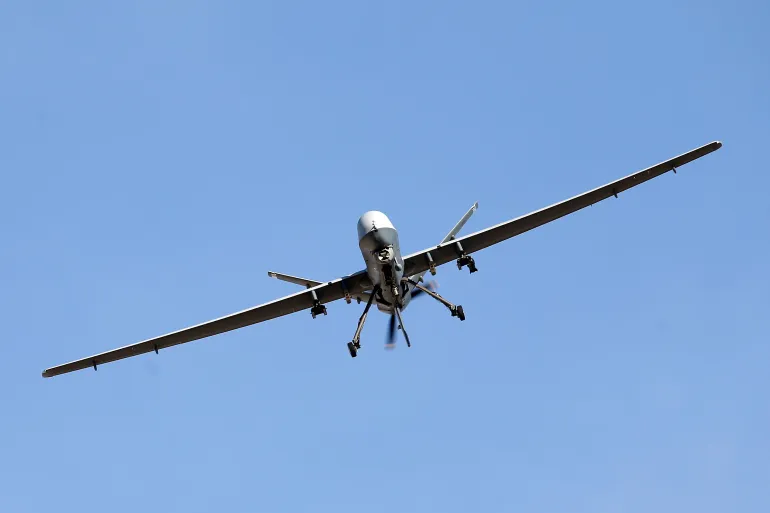

Garowe (KAAB TV) – Reports from Puntland indicate that U.S. forces, operating through the (AFRICOM), have recently carried out a series of drone strikes in the Bari region, an area long known to host entrenched bases of ISIS (locally known as Daesh).
These operations are believed to have focused on key militant positions in the Cal-Miskaad mountain range, southeast of Bosaso, where ISIS fighters have maintained fortified hideouts for years.
Local security officials in Puntland state that the strikes repeatedly hit defensive positions controlled by ISIS militants, disrupting their fortifications and directly supporting the ongoing operations of Puntland’s own defense forces.
These mountainous zones have been central to ISIS-Somalia’s activities, serving as both training areas and logistical hubs for their armed cells.
Although Puntland authorities have confirmed that U.S. drones conducted the attacks, specific details on the extent of the damage, the number of militants killed, or the identities of any high-ranking individuals targeted have not yet been released.
AFRICOM has acknowledged some recent operations in the region but, as is common with counterterrorism missions, not all strike details have been made public.
Initial assessments from earlier operations in the area this year indicated that several ISIS operatives were eliminated without reports of civilian casualties, but broader confirmation has yet to be provided.
Security forces in Puntland have carried out parallel ground and air operations, claiming significant successes, including the elimination of dozens of ISIS fighters in recent months.
Some of these campaigns reportedly targeted senior members of ISIS-Somalia responsible for recruitment, financing, and coordinating regional activities.
Somali federal officials have emphasized that the aim of the combined Somali–U.S. operations is to disrupt the group’s capacity to plan attacks against civilians, security personnel, and international partners.
The Bari region has long been one of the most strategically important territories in Puntland’s security landscape. Its rugged terrain offers natural protection for insurgent groups, making it a center of persistent conflict between ISIS cells and regional security forces.
The latest drone strikes appear to be part of a wider counterterrorism initiative that involves close cooperation between Puntland forces, the Somali federal government, and U.S. military advisers.
While Puntland authorities have welcomed the air operations as essential to weakening ISIS’s presence, full transparency regarding casualties and collateral impact remains limited.
Some independent assessments have noted that drone activity in the region has contributed to displacement in surrounding rural communities, raising concerns about the humanitarian implications of such strikes.
Balancing operational secrecy with accountability continues to be a challenge for all parties involved.
Overall, these developments underscore a renewed effort to dismantle ISIS strongholds in northern Somalia.
As operations continue, the effectiveness of these strikes—along with their impact on regional stability and local populations—will remain an important focus for both Somalia and its international partners.