

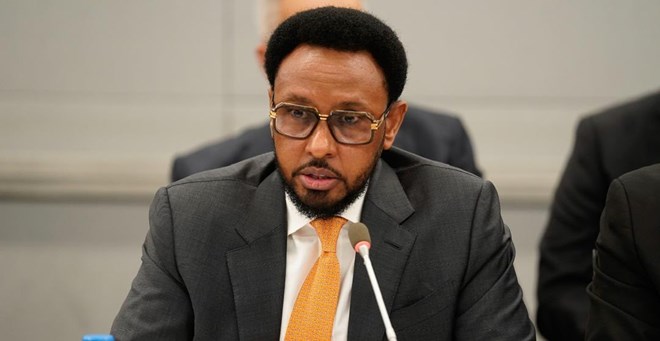

Mogadishu (KAAB TV) – In a recent interview with CNBC Arabia, Somalia’s Minister of Finance, Bihi Iman Egeh, painted a cautiously optimistic picture of the country’s economic trajectory: despite external headwinds, there has been notable progress — but sustaining growth will require bold reforms and sustained support.
According to the minister, Somalia achieved 4 percent real GDP growth in 2024, a strong showing considering the country’s fragility.
He warned that the growth outlook for 2025 is weakening considerably, with forecasts signaling a drop to “almost 1 percent.” He attributed this slowdown largely to a sharp decline in development assistance from key international donors, which has constrained the government’s capacity to leverage external financing for development.
These concerns align with broader assessments by multilateral institutions: the World Bank has noted that aid uncertainty is dampening growth prospects, given Somalia’s heavy dependence on external support.
Although the IMF’s 2024 Article IV Consultation raised growth projections to around 4 percent for both 2024 and 2025, it continued to emphasize elevated risks from political security issues, climate shocks, and volatile global conditions.
The government is pushing forward institutional reforms to deepen its tax base and make tax collection more efficient and transparent.
These reforms are underpinned by a Medium-Term Revenue Roadmap (2024–2027), which lays out steps to modernize taxation, increase compliance, and eventually reduce dependence on foreign aid.
Somalia has made significant investment in automating its tax and customs systems. According to the African Development Bank, systems like SOMCAS for customs and integrated tax tools (including mobile money integration) are now in operation.
These digital reforms, the minister argues, have boosted efficiency, reduced leakages, and made it easier for ordinary citizens and businesses to comply.
Domestic revenue reportedly rose by more than 80 percent over the last three years, according to the minister. While his interview did not provide detailed breakdowns, independent data shows that in 2024 Somalia collected around US$369 million in domestic revenues, a 12 percent increase over 2023.
The rise was driven by growth across various tax categories — income tax, sales tax, customs duties, and especially rental and sales taxes.
This stronger fiscal base has had real budgetary effects: the national budget grew by roughly 24 percent in 2024–2025, according to reports.
One of the most notable shifts, according to the minister, is a change in how Somalia approaches external assistance:
Instead of relying on indiscriminate, blanket aid, Somalia is now advocating for targeted support — aid that aligns with its own development priorities, such as social protection, institution-building, and revenue mobilization.
This more strategic use of aid is intended to reinforce ownership and increase the effectiveness of international assistance.
Somalia has secured technical and financial support from the World Bank for its reform agenda. One such initiative, a Development Policy Financing (DPF), allocated US$125 million in grant support to back public finance reform, debt management, and climate-resilient private sector investment.
Meanwhile, through the HIPC (Heavily Indebted Poor Countries) Initiative, Somalia made a historic step: in December 2023, it reached the Completion Point, leading to very substantial debt relief.
To sustain momentum, the government is also aligning its tax policy frameworks with regional standards (e.g., East African Community protocols).
The interview underscores a dual reality: Somalia has made real, measurable progress under Finance Minister Bihi Iman Egeh — particularly in building its domestic revenue base — but the road ahead is fraught with structural and external challenges.
By continuing to deepen reforms, digitize revenue systems, and channel aid toward its own national priorities, Somalia is attempting to shift from fragile dependency to a more self-reliant, resilient state.
Whether it can sustain this trajectory will depend on both its reform discipline and the willingness of international partners to support its transformation in a strategic, aligned way.