

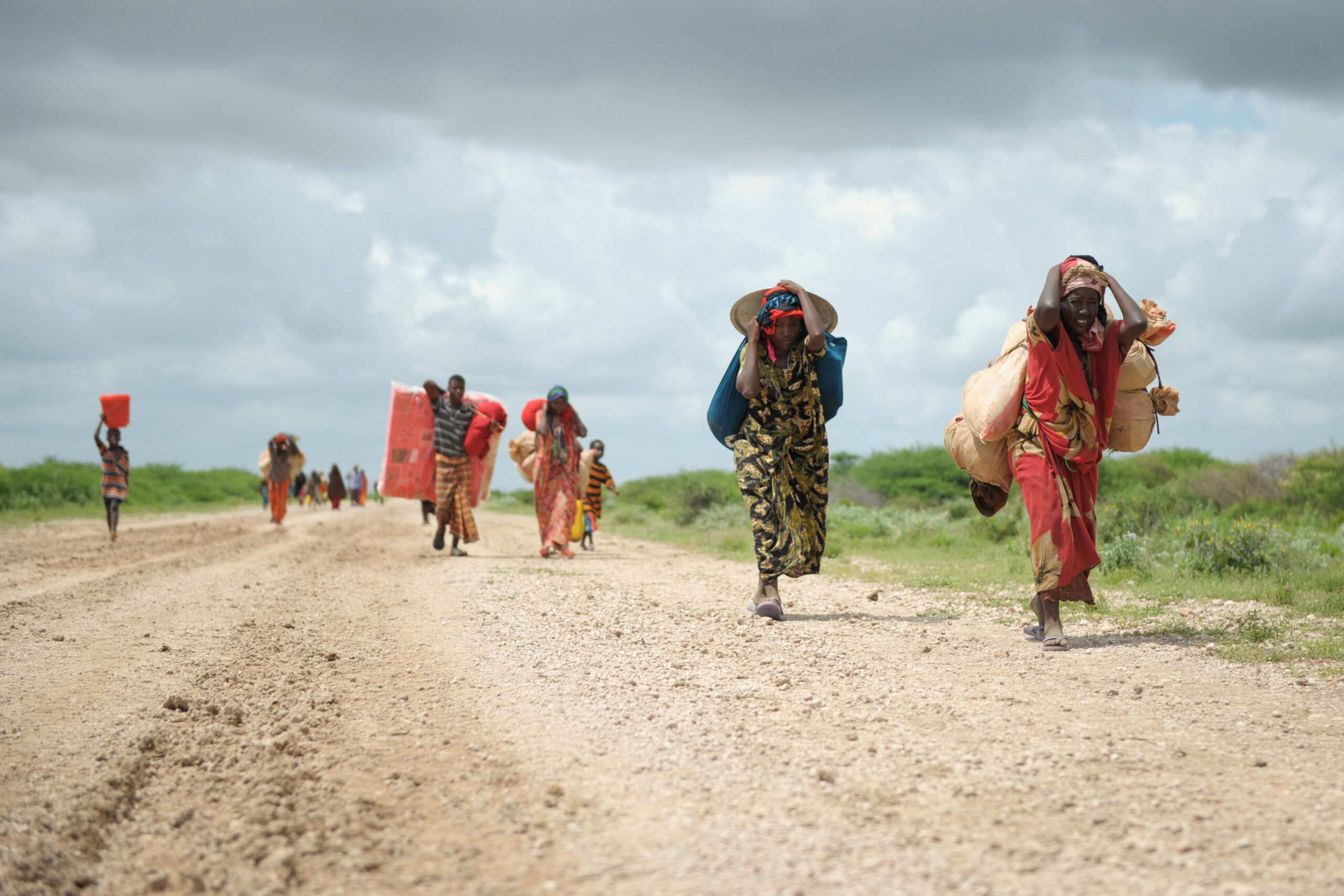

Mogadishu and Beledweyne — In central and southern Somalia, the front lines are moving backward. Despite years of military offensives and foreign support, Al-Shabab’s renewed raids have triggered one of the country’s worst waves of displacement in recent memory, exposing the limits of government control and the growing fragility of rural life in the heart of the conflict.
Among the thousands who fled is 42-year-old Halima Ahmed, who now sits under a patchwork tent on the outskirts of Beledweyne, clutching a tattered identity card and her youngest child.
“We run, we return, we run again,” she says. “Each time we lose something – a house, a relative, a piece of ourselves.”
Her story has become a familiar refrain across the river valleys of Middle and Lower Shabelle and the plains of Hiiraan. In this region, the heartland of Somalia’s struggle against Al-Shabab – entire communities are living in cycles of displacement, driven by a conflict that grinds on with devastating predictability.
A Crisis Renewed
According to new data from the European Union Agency for Asylum (EUAA) and other humanitarian monitors, nearly 700,000 people have been newly displaced across central Somalia this year alone.
Many fled after a series of Al-Shabab offensives that overran or encircled towns once thought secure under federal or regional control.
Between April 2023 and March 2025, the UNHCR’s Protection and Return Monitoring Network (PRMN) reported that conflict and insecurity were responsible for displacing roughly 600,000 people, part of a total of approximately 2.79 million newly displaced during that period.
Humanitarian access has collapsedin many of these areas. Aid convoys risk ambush; clinics have shuttered for lack of supplies.
“We can no longer tell whether we are moving forward or backward,” a senior aid coordinator in Mogadishu said.
“Every time we stabilize one district, the conflict shifts to another.”
Al-Shabab’s strategy, analysts say, has evolved.
Rather than holding territory, the group now seeks to punish local resistance and exhaust the population, creating a state of perpetual insecurity that undermines government authority even without direct control.
Humanitarian agencies face serious challenges delivering aid due to conflict, targeted attacks on aid workers, restrictions imposed by warring parties, including arbitrary taxation and bureaucratic hurdles, and physical constraints.
The Vanishing Towns
Images shared with agencies show concentric rings of destruction in rural Hiiraan, burnt croplands, collapsed homes, and expanding IDP settlements along riverbanks, according to a senior aid coordinator based in Mogadishu who had accessed the images.
Approximately 3.7 million people are currently internally displaced in Somalia, with worsening food insecurity closely linked to ongoing displacement patterns.
In Mahaas, once a trading hub linking Beledweyne and Mahas, schools have been closed, and some repurposed as makeshift barracks; classrooms now bear bullet scars.
Government forces, supported by clan militias, have retaken some positions, but without the resources to hold them.
The result is a slow, silent depopulation.
Towns empty out not in single mass exoduses but in waves, a few families at a time as fear outweighs the hope of rebuilding.
Humanitarian Gaps and Political Fault Lines
The displacement crisis is not only a humanitarian disaster but also a political one.
Relief agencies warn that federal-state rivalries, overlapping jurisdictions, and inconsistent security coordination have left many displaced communities stranded between administrations.
Local officials in Hirshabelle, and Galmudug accuse Mogadishu of neglect; federal ministries blame donors for shrinking aid budgets.
Meanwhile, Al-Shabab continues to exploit the vacuum, levying “taxes” on trade routes and offering rudimentary justice in areas where formal courts no longer function.
A senior regional officer in Beledweyne described the situation bluntly:
“We are fighting an enemy that does not need to win, it just needs us to fail.”
Lives in Limbo
In Beledweyne’s sprawling displacement camp known as Xaawo Taako, tents stretch beyond sight. Children with dust-coated faces chase each other between rows of water jerrycans.
Aid workers estimate that nearly 30,000 new arrivals have settled here since July.
Halima, the mother from Buq-Aqable, receives a small ration every two weeks, a sack of flour, some oil, and sometimes beans. Her husband remains missing, last seen when the militants attacked their village.
“They say peace will come,” she says softly. “But peace never stays.”
For many, the cycle of return and flight has eroded the very idea of home. The line between refugee and resident blurs.
“We are not moving toward anything,” said one local elder.
“We are only moving away.”
Somalia’s military campaign, once buoyed by international backing and domestic enthusiasm, is straining.
The drawdown of the African Union Transition Mission (ATMIS), now replaced by the under-resourced AUSSOM force, has left security vacuumsin critical corridors.
Meanwhile, the Somali National Army remains underpaid and overstretched.
Analysts warn that without sustained funding and coordination, recent territorial gains could unravel. “Security progress in Somalia is like a sandcastle,” said a foreign diplomat familiar with the region.
“Every tide of violence reshapes it.”
The government in Mogadishu insists it remains committed to stabilization, pointing to new local reconciliation initiatives and drone-assisted counterterrorism operations. But on the ground, such victories feel distant.
Prospects and Pitfalls Ahead
As dusk falls over Beledweyne, the displaced begin lighting small fires to cook what little food they have. The horizon glows orange, from both the setting sun and the flames of distant skirmishes.
Somalia’s war has entered a phase where victory is measured not in captured territory, but in human endurance, the ability of families to rebuild, flee again, and somehow continue existing amid endless disruption.
For Halima and thousands like her, the question is no longer when they will return home, but whether home, as they once knew it, still exists.
— A local reporter in Beledweyne has contributed to this report
Abdi Guled is a Horn of Africa analyst and journalist with a focus on political risk, armed groups, and geostrategic competition in fragile states.