

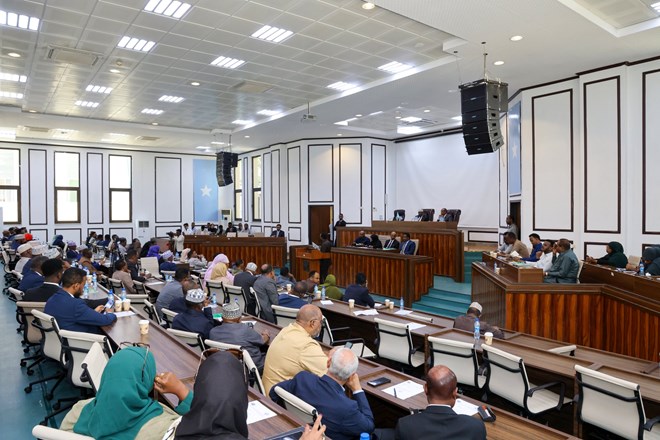

KISMAYO (KAAB TV) – A group of Somali Federal Parliament members representing the Jubaland region have issued a strong warning to President Hassan Sheikh Mohamud, urging him to refrain from interfering in the internal affairs of Jubaland administration.
In a joint statement signed by members of both the Upper House (Senate) and the House of the People, the lawmakers expressed serious concerns over what they described as renewed attempts to undermine Somalia’s federal system.
They accused President Hassan Sheikh of adopting tactics similar to those used during his previous presidency (2012–2017), which was marked by political tension and frequent clashes between the Federal Government and several Federal Member States, including Jubaland.
Allegations of Federal Overreach
The MPs allege that the Federal Government is once again attempting to weaken Jubaland’s autonomy through what they called “military provocations and political interference.” They warned that any effort to create a parallel administration in Jubaland—outside of its current leadership under President Ahmed Mohamed Islam (Madobe)—would be viewed as unconstitutional and destabilizing.
“This is a dangerous step that undermines the federalism enshrined in the Provisional Constitution,” read the statement. “The actions being taken mirror the failed strategies of the past and threaten to erode the fragile trust between the Federal Government and Member States.”
Accusations of Politicizing Security Forces
The statement also raised alarm over the alleged misuse of national security forces for political purposes.
The MPs accused the Federal Government of deploying Somali National Army units to advance political agendas in Jubaland, rather than focusing on the shared threat of terrorism.
“There is growing concern that security forces—both federal and regional—are being diverted from the fight against Al-Shabaab to pursue political objectives,” the MPs said. “This undermines national security and divides our forces at a critical time.”
They also warned that inflaming clan-based tensions for political leverage could damage social cohesion across the country.
A Call for Dialogue and National Unity
The parliamentarians called on the Federal Government, Federal Member States, national political stakeholders, and the international community to prioritize dialogue and consensus over confrontation.
They emphasized that long-term peace and state-building efforts in Somalia require cooperation, mutual respect, and adherence to the constitutional framework.
“We believe that only through genuine dialogue and consensus-based leadership can Somalia achieve sustainable peace and security,” the lawmakers stated. “All political actors must set aside personal interests and unite against the common enemy: terrorism.”
The MPs reiterated their support for the Federal system and called for strengthened cooperation between the Federal Government and Federal Member States, particularly in the areas of governance, security, and development.
Failed Talks in Kismayo
The warning comes in the wake of President Hassan Sheikh Mohamud’s recent visit to Kismayo, the administrative capital of Jubaland, aimed at resolving political disagreements with Jubaland President Ahmed Madobe.
However, the negotiations reportedly ended without a breakthrough, intensifying political friction both in Kismayo and the capital, Mogadishu.
The political standoff has raised fears of renewed conflict, and many observers are urging all parties to avoid repeating the missteps of the past, which led to protracted institutional paralysis and weakened Somalia’s state-building efforts.
Background:
Somalia’s Federal system was established under the 2012 Provisional Constitution, which recognizes the autonomy of Federal Member States such as Jubaland, Puntland, Galmudug, South West, and Hirshabelle.
However, political tensions between the central government and these states have been a recurring challenge, often flaring up around elections, resource sharing, and security control.
President Hassan Sheikh Mohamud, elected in May 2022 for a second term, pledged to prioritize reconciliation and federal cooperation.
However, his administration has been criticized by regional leaders for what they perceive as overcentralization and lack of consultation.
As Somalia continues to fight Al-Shabaab insurgents, many analysts warn that political infighting only strengthens extremist groups and delays progress toward national stability and democratic governance.