

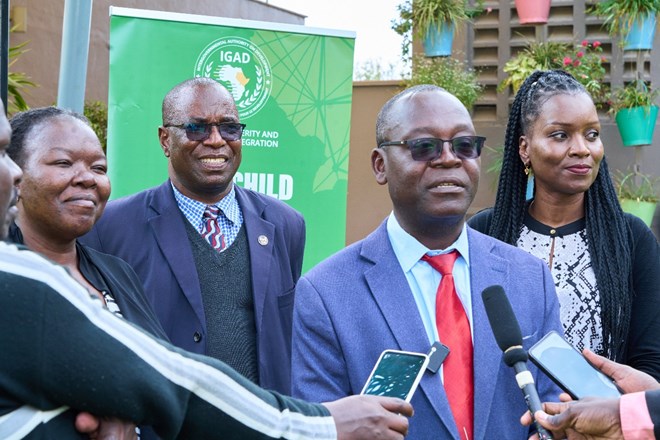

NAIROBI (KAAB TV) – The long-term success of a new regional child protection framework hinges on how seriously governments commit to funding child welfare programs, regional experts have warned.
Speaking at the Intergovernmental Authority on Development (IGAD) Regional Conference on Child Protection held in Nairobi, Kenya’s Secretary of Children Services, Shem Nyakutu, emphasized that while national budgets do allocate some resources for child welfare, the funding remains grossly inadequate in the face of escalating challenges.
“The Kenyan government has given us a budget for children, and our friends in the region are also contributing. However, mobilizing sufficient resources is still a major challenge,” Nyakutu stated.
He highlighted the high costs involved in child protection operations, citing cases where government funds were used to rescue citizens—including children—who were trafficked or stranded abroad. These rescue missions, he noted, underscore the growing financial strain on child protection agencies.
Nyakutu urged county governments to align their financial planning with the Children Act 2022, which mandates the establishment of child protection centers and the adoption of supportive local policies.
“Counties must invest directly in child protection to complement the efforts of both national and regional governments,” he said.
Regional Challenges Require Unified Action
The IGAD conference aims to formalize a regional framework to protect children from harmful traditional practices, human trafficking, displacement, and the worsening impacts of conflict and climate change.
“Across the region, children are exposed to harmful practices such as female genital mutilation (FGM), child marriage, corporal punishment, and various forms of exploitation. We are also contending with increasing insecurity and trafficking. This new framework ensures that child protection is not just a national issue but a regional imperative,” said Nyakutu.
He reiterated that the 2022 Children’s Act places an obligation on states to establish effective child protection mechanisms and adopt policies that are harmonized with national and international standards. He called on local legislative councils to enact supporting laws to ensure grassroots implementation and sustainability.
Funding and Political Will Are Crucial
Nyakutu confirmed that while Kenya has allocated government resources for children’s services—with additional support from development partners and the private sector—the current investment is still not enough to meet the growing need.
“Even in combating trafficking, we have used state resources to rescue citizens stranded in foreign countries. Protecting children is and must remain a government priority,” he asserted.
Dr. Harriet Nabukwasi, a reproductive health expert from the IGAD Secretariat, echoed Nyakutu’s sentiments, stressing that child protection must become a top-level political agenda across member states.
“IGAD complements national efforts by mobilizing regional resources and ensuring that cross-border child protection issues are addressed in high-level political forums,” she said.
A Call to Move from Rhetoric to Action
Representing Save the Children Kenya and Madagascar, Chief Counsel Sandra Mosoga emphasized that children in sub-Saharan Africa remain deeply vulnerable to poverty, conflict, displacement, cyber exploitation, and climate-induced disasters.
“We must go beyond statements. This means allocating adequate budgets, strengthening enforcement mechanisms, and putting children’s voices at the center of decision-making,” she said.
Mosoga also warned that data gaps and weak policy enforcement continue to hamper child protection efforts across the region. She called for greater investment in data systems, accountability frameworks, and community-level child services.
The IGAD Child Protection Action Plan, currently under development, is expected to set regional standards, enhance cooperation between member states, and mobilize both public and private resources to tackle the systemic threats facing children in East Africa and the Horn of Africa.
If successfully implemented and adequately funded, the framework could mark a significant shift in how child protection is addressed—moving from fragmented national responses to a coordinated regional approach capable of addressing both cross-border and localized challenges.